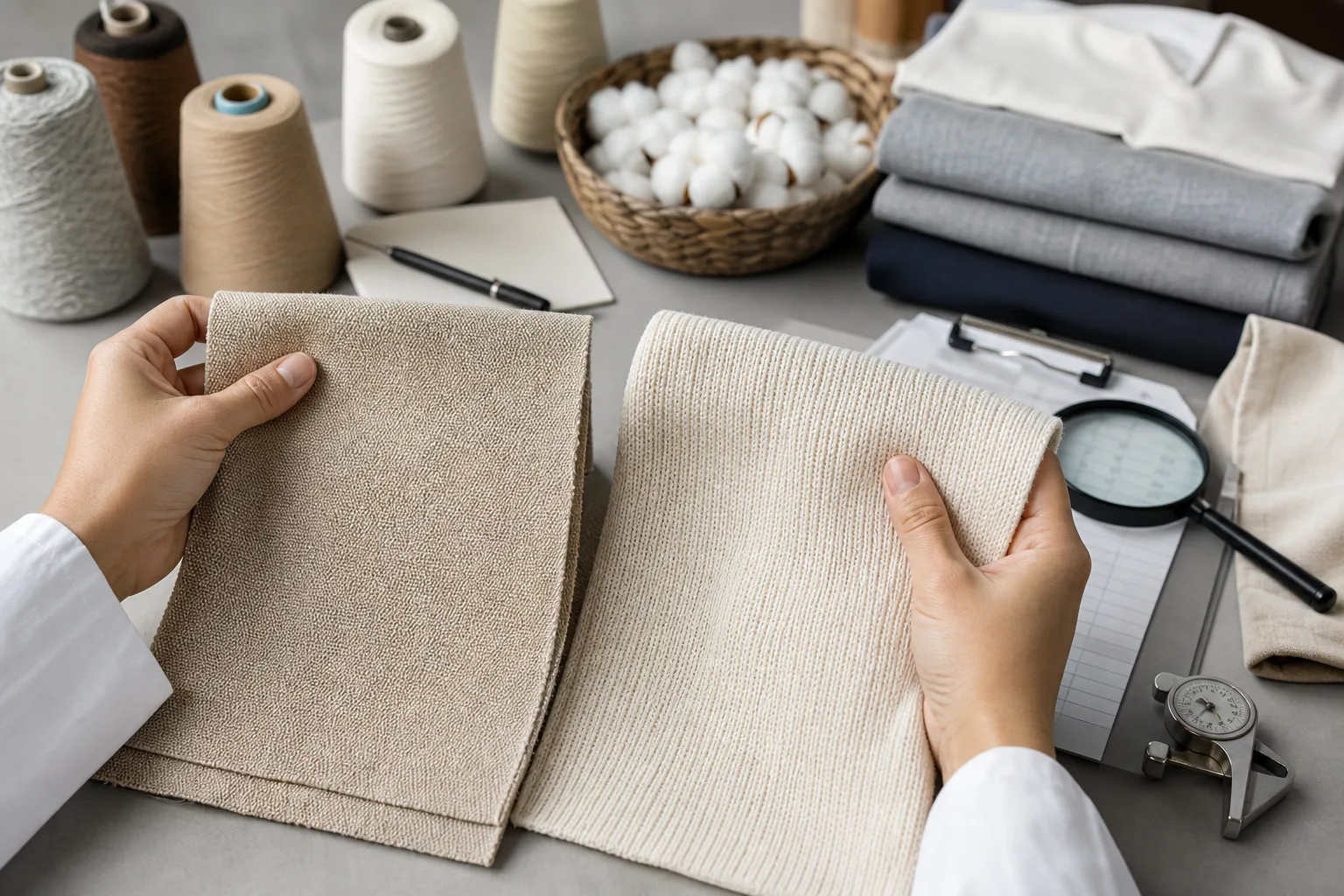
The main difference between woven and knitted cotton is construction: woven fabric interlaces lengthwise and crosswise yarns, while knitted fabric forms connected yarn loops. Wovens are generally more dimensionally stable and structured; knits usually stretch and conform more readily. Neither is inherently softer, stronger, more breathable or higher quality. Those results also depend on the cotton fiber, yarn, fabric density, finishing and intended use.
How woven and knitted cotton are made
Woven cotton interlaces warp and weft
Weaving uses two yarn systems. Warp yarns run along the fabric's length and are held under tension on a loom. Weft, also called filling, passes across the width. The order in which these yarns cross creates the weave design. CottonWorks defines weaving as the interlacing of two sets of yarns to form a fabric structure. ([cottonworks.com](https://cottonworks.com/learning-hub/weaving/weaving-basics/?utm_source=openai))
Plain weave has frequent interlacings and can produce fabrics such as muslin, canvas and percale. Twill shifts the interlacings to create diagonal lines, as seen in denim and chino. Sateen uses longer filling-yarn floats to create a smoother face. These are meaningful construction terms, but none is a quality grade by itself. A poorly specified sateen can perform worse than a well-engineered plain weave.
Knitted cotton forms loops
Knitting draws yarn into loops that intermesh with adjacent loops. Horizontal rows are called courses, and vertical columns are called wales. Because the loops can change shape and move relative to one another, knitted fabrics usually stretch and recover more easily than comparable wovens. CottonWorks notes that knits are generally more conformable, while stitch length helps control fabric tension, weight and width. ([cottonworks.com](https://cottonworks.com/learning-hub/knitting/knit-basics/?utm_source=openai))
Common cotton knits include single jersey for T-shirts, rib for neckbands and fitted garments, interlock for smoother double-knit fabrics, and pique for polo shirts. Most everyday cotton apparel knits are weft-knitted, although warp knitting is also used in textile manufacturing.
Construction is not the same as fiber quality
“Woven,” “knitted” and “100% cotton” answer different questions. Woven or knitted identifies how a fabric is constructed. Cotton identifies its fiber content. Neither statement alone tells you the cotton variety, fiber measurements, yarn system, fabric density, finish or expected service life.
Fiber properties influence the yarn
Before cotton becomes either fabric type, it must be spun into yarn. Important raw-fiber measurements include length, length uniformity, strength, micronaire, color and non-lint content. USDA cotton classification uses instrument testing to measure these properties, while trained classers inspect samples for extraneous matter. Mills use the resulting data to select cotton for particular manufacturing requirements. ([ams.usda.gov](https://www.ams.usda.gov/services/grading/cotton-classing))
Longer, more uniform and appropriately selected fibers can support smoother, more even yarns, but no single fiber measurement guarantees a superior finished product. Yarn twist, spinning method, ply, count and processing control also matter. See the guides to staple length, micronaire, fiber strength and length uniformity for the limits and uses of each metric.
Yarn and construction must suit each other
Warp yarns experience tension and abrasion during weaving, so their design and preparation may differ from yarns selected for knitting. Knitting commonly operates at lower yarn tension but repeatedly bends the yarn into loops. A yarn that performs well in one process is not automatically optimal for the other.
Fabric specifications should therefore describe more than fiber content. Useful woven metrics include weave, warp and weft yarn sizes, ends and picks per unit of length, and fabric weight. Knit specifications may include stitch type, machine gauge, courses, wales, stitch length and fabric weight. Thread count is principally a woven-fabric construction measure; it is not a substitute for knit gauge, stitch density or weight.
Woven vs knitted cotton performance
The following table describes common tendencies, not guarantees. A dense interlock knit may be more stable than a very open woven gauze, while elastane, mechanical finishes or garment design can substantially change performance.
| Characteristic | Woven cotton | Knitted cotton | What to verify |
|---|---|---|---|
| Structure | Two yarn systems interlace | Yarn forms connected loops | Named weave or knit stitch |
| Natural stretch | Usually limited, especially on grain | Usually greater, particularly across weft knits | Stretch and recovery specification; blend content |
| Shape and stability | Generally holds a defined shape well | Generally conforms and drapes more readily | Laundering dimensional-change results |
| Edges and damage | Cut edges may fray | Some structures curl, run or unravel | Seam, edge and stitch construction |
| Typical products | Shirts, jeans, trousers, sheets and structured home textiles | T-shirts, underwear, polos, sweatshirts and fitted apparel | Whether construction matches the product's use |
| Quality language | Thread count may be relevant but is incomplete | Gauge and stitch measures may be relevant but are incomplete | Fiber, yarn, density, weight, finish and tested performance |
Stretch does not necessarily mean recovery
A cotton knit can extend because its loops rearrange, but extension alone does not prove that the fabric will return fully to its original dimensions. Recovery depends on stitch structure, density, yarn properties, finishing and any added elastic fiber. Likewise, a woven fabric cut on the bias can stretch more than it does along the warp or weft.
Breathability and softness require context
Construction affects air pathways and surface feel, but broad rules are unreliable. An open woven gauze can allow more air movement than a heavy knit fleece. A finely knitted jersey can feel smoother than a coarse canvas, while a brushed woven fabric can feel softer than an untreated knit. Compare fabric weight, thickness, density and finish instead of treating “knit” or “woven” as a complete comfort rating. The guides to cotton breathability and moisture absorption explain these distinctions.
Finishing and care can change the result
Fabric leaving a loom or knitting machine is not necessarily the fabric consumers encounter. Preparation, dyeing, washing, compacting, calendaring, brushing, mercerization, resin treatments and other finishes can alter appearance, dimensions, hand and care requirements.
Shrinkage is a product specification, not a cotton constant
Both woven and knitted cotton can change dimensions during laundering. CottonWorks explains that shrinkage is affected by fabric construction, processing stresses, sewing and finishing. Knit variables include yarn structure, stitch type, stitch length and finishing technique. ([cottonworks.com](https://cottonworks.com/learning-hub/quality-assurance/shrinking-and-skewing/?utm_source=openai)) Knits may be especially susceptible to width or length changes when loops relax, but a manufacturer can reduce that risk through appropriate construction and finishing.
Consumers should follow the permanent care label rather than assuming all cotton tolerates the same temperature or drying method. The FTC Care Labeling Rule requires covered apparel to carry instructions that provide a safe method of regular care. ([ftc.gov](https://www.ftc.gov/legal-library/browse/rules/care-labeling-textile-wearing-apparel-certain-piece-goods-text?utm_source=openai)) Lower drying temperatures and avoiding unnecessary overdrying may help limit shrinkage and surface wear when permitted by the label. See washing cotton, drying cotton and preventing shrinkage.
Finishes should be named precisely
Terms such as “peached,” “brushed,” “wrinkle resistant” or “pre-shrunk” describe processing or an intended result, not an overall quality level. Buyers should ask what performance requirement supports the term. For example, “pre-shrunk” does not logically mean zero future dimensional change unless a specific tolerance and test method are supplied.
How to read labels and marketing claims
In the United States, most covered textile products must identify fiber content, country of origin and the responsible manufacturer or marketer. A product should not be labeled “100% cotton” unless its textile fiber content is cotton, apart from permitted exclusions such as certain trim. If a named cotton type is used, the statement must accurately describe its share of the product. ([ftc.gov](https://www.ftc.gov/business-guidance/resources/calling-it-cotton-labeling-advertising-cotton-products-0?utm_source=openai))
Fiber content still does not disclose construction. A 100% cotton woven shirt and a 100% cotton jersey T-shirt can have very different stretch, weight and care behavior. Conversely, two cotton jersey products can differ because one uses finer yarn, tighter stitches, a different finish or a blend containing elastane.
Marketing terms are not laboratory results
- Premium, luxury and hotel quality: subjective unless tied to measurable specifications.
- Breathable: plausible for many cotton products but not a quantified air-permeability result.
- Durable: incomplete without defining resistance to abrasion, tearing, bursting, pilling, laundering or another relevant failure mode.
- Combed or ring-spun: meaningful yarn-processing descriptions, but not guarantees of total product quality. Compare combed vs carded cotton and ring-spun vs open-end yarn.
- High thread count: relevant only within a properly described woven construction and should not replace evaluation of yarn, weave, weight and finishing. See the thread count guide.
Sustainability and market role
Construction alone does not establish environmental preference
It is not defensible to call knitted cotton more sustainable than woven cotton, or the reverse, solely because of construction. A useful assessment must define its scope and consider relevant factors such as cotton sourcing, spinning, fabric production, coloration, finishing, material yield, product durability, care and end-of-life assumptions. Results can change with the product, factory, energy system and study boundaries.
The FTC advises marketers not to make broad, unqualified environmental claims such as “green” or “eco-friendly.” Specific claims should be clear and supported, and third-party seals do not remove the need to substantiate what is communicated. ([ftc.gov](https://www.ftc.gov/news-events/topics/truth-advertising/green-guides?utm_source=openai)) A certification or sourcing program should be evaluated for its actual scope rather than treated as proof of every possible environmental or quality benefit. See cotton certifications and the sustainability hub.
Each construction serves a distinct market role
Wovens remain central where tailoring, controlled dimensions, defined drape or abrasion-resistant structures are important, including shirting, denim, workwear and bedding. Knits are prominent where comfort, body movement, stretch or efficient tubular and shaped production are priorities, including T-shirts, underwear, polos and sweatshirts. Product developers may also combine them—for example, a woven garment with a knit collar or stretch panel.
Practical sourcing checklist
- Confirm the fiber percentages instead of relying on a cotton-related product name.
- Identify the exact weave or knit structure.
- Record yarn type and size, fabric weight and relevant density measures.
- Define required stretch, recovery and dimensional-change tolerances.
- Select tests appropriate to the failure risks, such as woven tear or knit bursting performance.
- Document dyeing and finishing treatments that may affect care or appearance.
- Check labels and environmental claims against traceable evidence.
- Judge the fabric in the context of its intended product, not by one headline metric.
For broader manufacturing context, visit the cotton industry hub, cotton supply chain guide and cotton quality buying guide.
Frequently asked questions
Is woven cotton better quality than knitted cotton?
No. They are different construction systems suited to different products. Quality depends on fiber selection, yarn, fabric structure, density, finishing, manufacturing control and whether the product meets its intended performance requirements.
Which stretches more, woven or knitted cotton?
Knitted cotton usually stretches more because its loops can change shape. Most woven cotton has less natural stretch along the warp and weft, although bias cutting, open structures, finishes and elastic-fiber blends can alter the result.
Does 100% cotton indicate whether fabric is woven or knitted?
No. It identifies fiber content, not construction. A 100% cotton product may be woven, knitted or made using another textile construction method.
Which type of cotton fabric shrinks more?
There is no universal percentage. Knits can be more prone to dimensional relaxation, but shrinkage in either type depends on yarn, construction, processing, finishing and laundering. Follow the care label and look for a stated dimensional-change tolerance when performance is critical.
How this guide was prepared
This page is based on desk research of technical guidance from CottonWorks, USDA cotton-classing information and current FTC textile-labeling, care-labeling and environmental-marketing guidance accessed on October 6, 2026. It does not claim first-hand mill visits, laboratory testing, product trials or certification audits.
Review status: Publishable quality advisory.
Sources and scope
- Weaving BasicsCottonWorks
Definition of weaving, warp preparation and the interlacing of two yarn systems.
Accessed 2026-10-06 - Knit BasicsCottonWorks
Knit loop structure, courses, wales, stitch length, stretch and differences between weft and warp knitting.
Accessed 2026-10-06 - Cotton Fiber QualityCottonWorks
Cotton fiber measurements and their relationships to yarn processing and fabric performance.
Accessed 2026-10-06 - Cotton Classing ServicesUSDA Agricultural Marketing Service
USDA instrument measurements, classer inspection and the role of bale-specific classification data.
Accessed 2026-10-06 - Calling It Cotton: Labeling and Advertising Cotton ProductsFederal Trade Commission
United States fiber-content labeling requirements and rules for claims involving named cotton types.
Accessed 2026-10-06 - Environmental Claims: Summary of the Green GuidesFederal Trade Commission
Guidance against broad, unqualified environmental claims and requirements for substantiation and clear qualifications.
Accessed 2026-10-06