
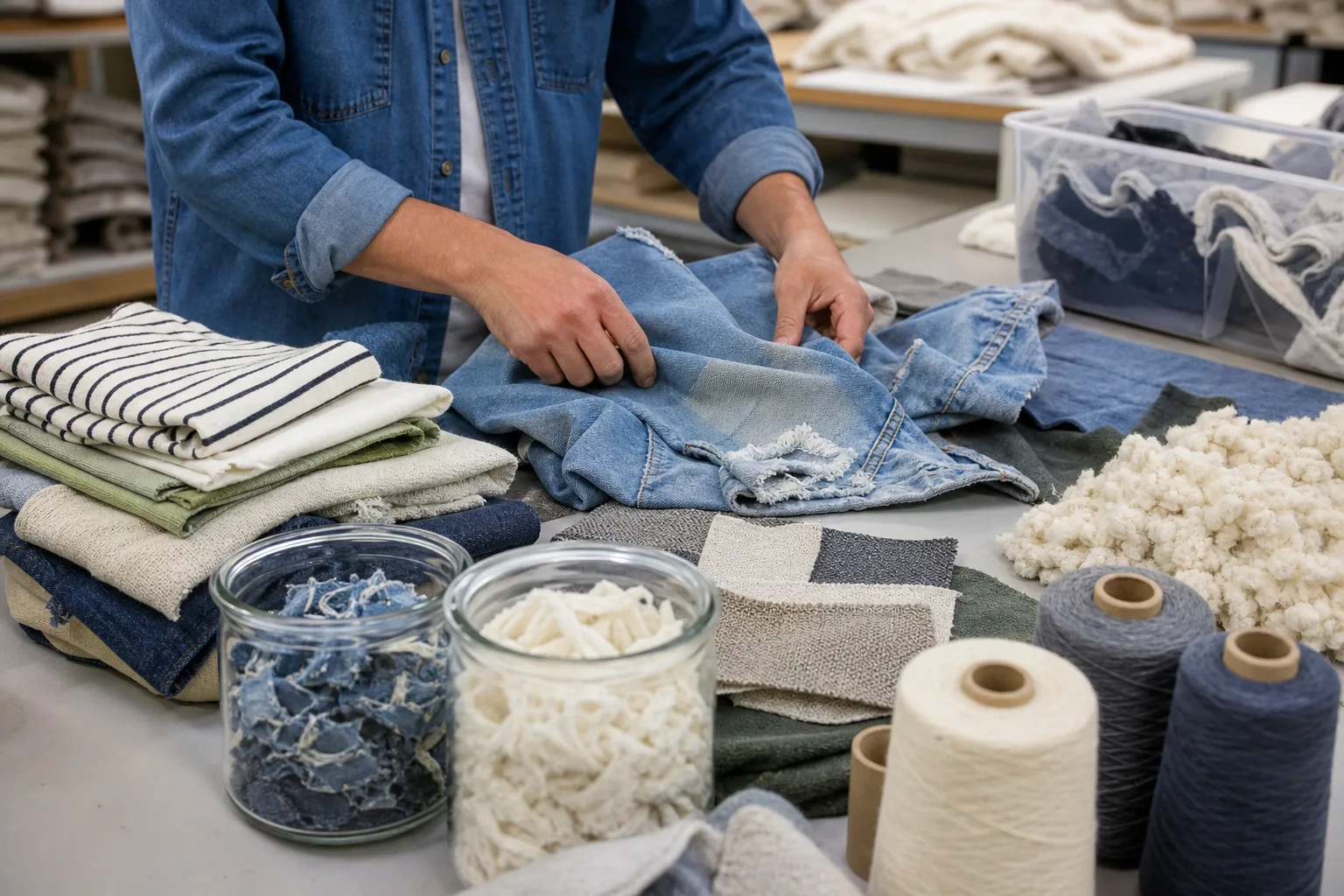
A cotton circular economy aims to keep cotton products and materials useful for as long as practical, then recover their value through reuse, repair or recycling instead of treating them as disposable. Cotton can support this model, but the fiber alone does not make a product circular. Results also depend on yarn quality, fabric construction, finishing, durability, care, collection systems and whether an end-of-life processor can actually accept the item. The better choice is therefore not simply “buy cotton.” It is to choose an appropriate, well-made product, use it fully and demand specific evidence for environmental claims.
What circularity means for cotton
Circularity is a system goal rather than a single material attribute. A practical hierarchy begins by avoiding unnecessary production, designing useful products that last, maintaining them, enabling repair and reuse, and recovering fibers or other materials when the original product can no longer serve its purpose. Disposal remains a last resort.
Cotton can move through several circular pathways. Wearable clothing may be resold or donated for reuse. Manufacturing scraps and used textiles may be mechanically recycled into fiber for yarn, nonwovens, insulation or filling. Other processes may recover cellulose for new applications. CottonWorks notes, however, that appropriate textile recycling facilities are available only in limited communities, so technical recyclability should not be confused with access to a working local system. CottonWorks circularity overview
A useful order of decisions
- Use less and specify well: avoid products that do not meet a genuine need.
- Keep products in service: prioritize suitable construction, care, repair and continued use.
- Reuse: preserve the product in its existing form when it remains safe and functional.
- Recycle: recover fiber or material when direct reuse is no longer realistic.
- Consider biological pathways cautiously: composting requires compatible materials, suitable conditions and an accepting facility.
This hierarchy matters because converting a textile back into usable material requires sorting, transport, processing and energy. Textile Exchange’s 2026 cotton life-cycle assessment also cautions that recycled cotton impacts depend substantially on electricity, transport and the location and infrastructure used for recycling. Textile Exchange cotton LCA
Fiber quality matters, but it does not determine the whole product
Cotton lint is an input, not a finished performance result. The USDA classifies cotton using measurements that include length, length uniformity, strength, micronaire, color and trash. These properties help mills select cotton for particular processing and product needs. Longer, more uniform fibers can support yarn strength and evenness, while fiber strength affects the force a fiber bundle can withstand. USDA cotton classing
Those measurements are valuable, but consumers cannot infer the lifespan of a shirt, towel or sheet from a cotton name alone. Yarn structure and twist, fabric weight and density, knitted or woven construction, seam quality, finishing, fit, use and laundering can all change real-world performance. CottonWorks similarly explains that fiber characteristics influence processing and yarn quality without replacing product-level evaluation. CottonWorks fiber quality guide
How the product layers affect circularity
| Product layer | What it can influence | What to verify |
|---|---|---|
| Fiber | Spinning performance, yarn evenness and potential strength | Relevant specifications or classification data when sourcing at industry level |
| Yarn | Strength, surface character, pilling tendency and fabric stability | Spinning method, yarn size, twist, evenness and intended end use |
| Construction | Abrasion resistance, stretch, dimensional stability and repairability | Fabric weight, density, knit or weave structure, seams and reinforcement |
| Finishing | Hand, appearance, shrinkage control, wrinkle behavior and other functions | Purpose of the finish, care requirements and effects on recovery options |
| Product design | Useful life, replaceable parts, disassembly and recyclability | Whether trims, coatings and blended components can be removed or processed |
| Care | Appearance retention, shrinkage, color change and premature damage | The permanent care label and instructions for the complete product |
There is no universal durability result attached to the word “cotton.” CottonWorks describes durability as a product-level issue involving strength, abrasion and pilling, with acceptable performance depending on the item and end use. Learn more about related mechanisms in our guides to abrasion resistance and pilling.
Recycled cotton has benefits and technical limits
Recycled cotton generally comes from two streams. Pre-consumer material includes manufacturing waste such as cutting scraps, while post-consumer material comes from used clothing, towels, upholstery and other products. The distinction is meaningful because post-consumer items often require more sorting and may contain mixed fibers, finishes, labels, sewing thread, elastane, fasteners or contamination.
Most recycled cotton has traditionally been produced through mechanical processing. Textiles are sorted and opened or shredded until they return to a fibrous form. This processing can shorten and entangle fibers, reducing length and length uniformity compared with the original input. Those changes can restrict yarn fineness, strength or end uses. Recycled cotton may therefore be blended with other fibers to reach a required performance level. CottonWorks recycled cotton guide
A blend is not automatically a poor choice. A small amount of another fiber may provide stretch, recovery or strength needed for a long useful life. The trade-off is that mixed materials can be harder to identify, separate and recycle. The right decision depends on the product’s function, expected service life and available recovery technology—not on a rule that every product must contain only one fiber.
Do not confuse recycled content with proven quality
“Recycled cotton” describes the source of some or all of the fiber. It does not, by itself, establish abrasion resistance, shrinkage, colorfastness, pilling performance, seam strength or expected lifetime. Brands and industry buyers should set measurable requirements for the finished product and use relevant testing rather than treating a recycled-content label as a quality result. Consumers can look for substantial construction, appropriate fabric weight, secure seams, replaceable components where relevant and care instructions they can realistically follow.
Read labels and circularity claims precisely
In the United States, a fiber-content statement identifies fibers by weight. An item labeled “100% cotton” should contain only cotton apart from qualifying trim, while a blend should state the percentages of its constituent fibers. This tells you composition; it does not prove that the cotton was organically grown, recycled, durable, recyclable in your area or produced with a lower overall impact. FTC cotton labeling guidance
The same discipline applies to environmental language. The Federal Trade Commission advises against broad, unqualified claims such as “green” or “eco-friendly.” Recycled-content claims should identify the proportion when a product is only partly recycled, and recyclable claims may need qualification when suitable facilities are not widely available. FTC Green Guides summary
What a certification can—and cannot—show
Textile Exchange’s Recycled Claim Standard verifies and tracks recycled raw material through a chain-of-custody system. Its scope is recycled-content integrity; it does not by itself address chemical use or broader social and environmental production performance. The Global Recycled Standard adds requirements related to processing, chemicals and social and environmental practices. These standards can strengthen a content claim, but neither logo should be interpreted as proof that a particular product will be durable, easy to repair or accepted by a local recycler. Textile Exchange RCS and GRS overview
- Ask whether a percentage applies to the whole product, its main fabric or only the packaging.
- Distinguish pre-consumer from post-consumer recycled content.
- Check whether certification covers the product and supply chain, not merely a supplier or facility.
- Treat “recyclable” as incomplete unless a realistic collection and processing route is identified.
- Do not interpret organic, preferred or responsibly sourced cotton claims as automatic evidence of product circularity.
Better choices for consumers and industry
Consumer checklist
- Buy for a defined use. Select the construction and weight that fit the job rather than relying on a premium cotton name.
- Inspect the whole item. Look at seams, hems, closures, high-wear areas, fabric recovery and whether decorative elements appear secure.
- Read both labels. Fiber content explains composition; the care label explains permitted cleaning and drying methods.
- Prefer maintainable products. Consider whether stains can be treated, parts repaired and the item cleaned without impractical specialist care.
- Use before replacing. Repair, alter, rotate or repurpose an item while it remains functional.
- Choose the next route honestly. Resale and donation are appropriate only for usable goods. Worn-out textiles require a recycler or collection program that accepts their composition.
Follow the product label rather than assuming every cotton item tolerates the same treatment. The FTC requires care instructions for covered garments so buyers know how to clean them safely. Lower-impact habits must remain compatible with those instructions: wash only when needed, treat stains promptly, use an appropriate cycle, avoid excessive detergent and dry gently when the product permits. See our practical guides to washing cotton, drying cotton and preventing shrinkage.
Industry checklist
- Define the intended lifetime and performance requirements before selecting fiber content.
- Specify yarn, construction, finishing and finished-product tests relevant to the end use.
- Record recycled content, source category and chain-of-custody evidence.
- Design trims, threads, labels, coatings and accessories with repair and recovery in mind.
- Test the completed product after realistic care cycles instead of relying only on raw-fiber data.
- Qualify environmental claims by stating the measured attribute, percentage, boundary and verification method.
- Connect take-back messaging to a documented sorting and processing route.
For upstream context, explore the cotton supply chain, HVI testing and our overview of how to assess cotton quality.
Composting and biodegradability need careful boundaries
Cotton is primarily cellulosic, but a finished textile is rarely just raw cellulose. Dyes, durable finishes, coatings, sewing threads, elastic, prints, buttons, zippers and labels can affect how an item behaves and whether a composting operation will accept it. “Biodegradable” also does not specify the environment, time, completeness of breakdown or treatment of non-cotton components.
Composting should therefore not be presented as the default end point for cotton clothing. Confirm the full composition and obtain acceptance from a suitable facility before using that route. Home compost claims require particularly careful substantiation. The FTC warns that unqualified degradable claims can be misleading when products normally enter landfills, incinerators or recycling systems where the claimed breakdown conditions may not exist. FTC environmental claims guidance
The strongest cotton circular economy strategy combines several actions: appropriate farming and sourcing, efficient production, durable product design, realistic care, repair, reuse and credible recovery systems. No label resolves every stage. For broader environmental context, visit the cotton sustainability hub, including guides to soil health, water use and carbon footprint.
Frequently asked questions
Is 100% cotton automatically circular?
No. A 100% cotton label describes fiber composition, not durability, repairability, recycled content or access to recycling. Circularity depends on the complete product and the systems used to maintain, reuse and recover it.
Is recycled cotton lower quality than virgin cotton?
Mechanical recycling can shorten cotton fibers and reduce length uniformity, which may limit some yarns and applications. Finished quality still depends on blending, yarn engineering, construction, finishing and whether the product meets suitable performance requirements.
Are cotton-polyester or cotton-elastane blends incompatible with circularity?
Not automatically. A blend may provide strength, stretch or recovery that extends useful life, but mixed fibers can be harder to separate and recycle. The trade-off should be evaluated against the product's function and available recovery routes.
Can worn-out cotton clothing go into home compost?
Do not assume it can. Finished clothing may contain synthetic thread, elastic, trims, coatings, dyes or finishes, and home conditions may not support complete breakdown. Verify the entire composition and follow the rules of an accepting composting facility.
How this guide was prepared
This guide is based on desk research completed on October 12, 2026 using USDA cotton classification information, CottonWorks technical education, Textile Exchange standards and life-cycle materials, and Federal Trade Commission labeling and environmental-claims guidance. It does not rely on first-hand product testing, laboratory analysis, factory or farm visits, certification audits, supplier interviews or consumer trials. Product performance and end-of-life options remain dependent on the specific construction, treatments, use conditions and locally available collection infrastructure.
Sources and scope
- Cotton Classing ServicesUSDA Agricultural Marketing Service
Explains the USDA cotton classification measurements used to characterize fiber length, uniformity, strength, micronaire, color and trash.
Accessed 2026-10-12 - Cotton Fiber QualityCottonWorks / Cotton Incorporated
Provides technical context for how cotton fiber properties affect spinning, yarn strength and evenness without determining every finished-product result.
Accessed 2026-10-12 - Recycled CottonCottonWorks / Cotton Incorporated
Describes pre-consumer and post-consumer cotton waste, mechanical recycling and the effects of shredding on fiber length and uniformity.
Accessed 2026-10-12 - Cotton Life Cycle Assessment StudyTextile Exchange
Provides life-cycle context, including the importance of electricity, transport, location and infrastructure to recycled cotton impacts.
Accessed 2026-10-12 - Recycled Claim Standard and Global Recycled StandardTextile Exchange
Explains the purposes, chain-of-custody provisions and differing scopes of the RCS and GRS.
Accessed 2026-10-12 - Calling It Cotton: Labeling and Advertising Cotton ProductsFederal Trade Commission
Explains U.S. requirements for truthful cotton fiber-content statements and percentage disclosures.
Accessed 2026-10-12 - Environmental Claims: Summary of the Green GuidesFederal Trade Commission
Supports guidance on qualified recycled-content, recyclable, degradable and general environmental-benefit claims.
Accessed 2026-10-12
Questions & discussion
Share a question or a useful experience about this guide. Comments appear immediately. Your name and comment are public. Email is optional and stays private; reply emails are not enabled yet. Comment privacy.