
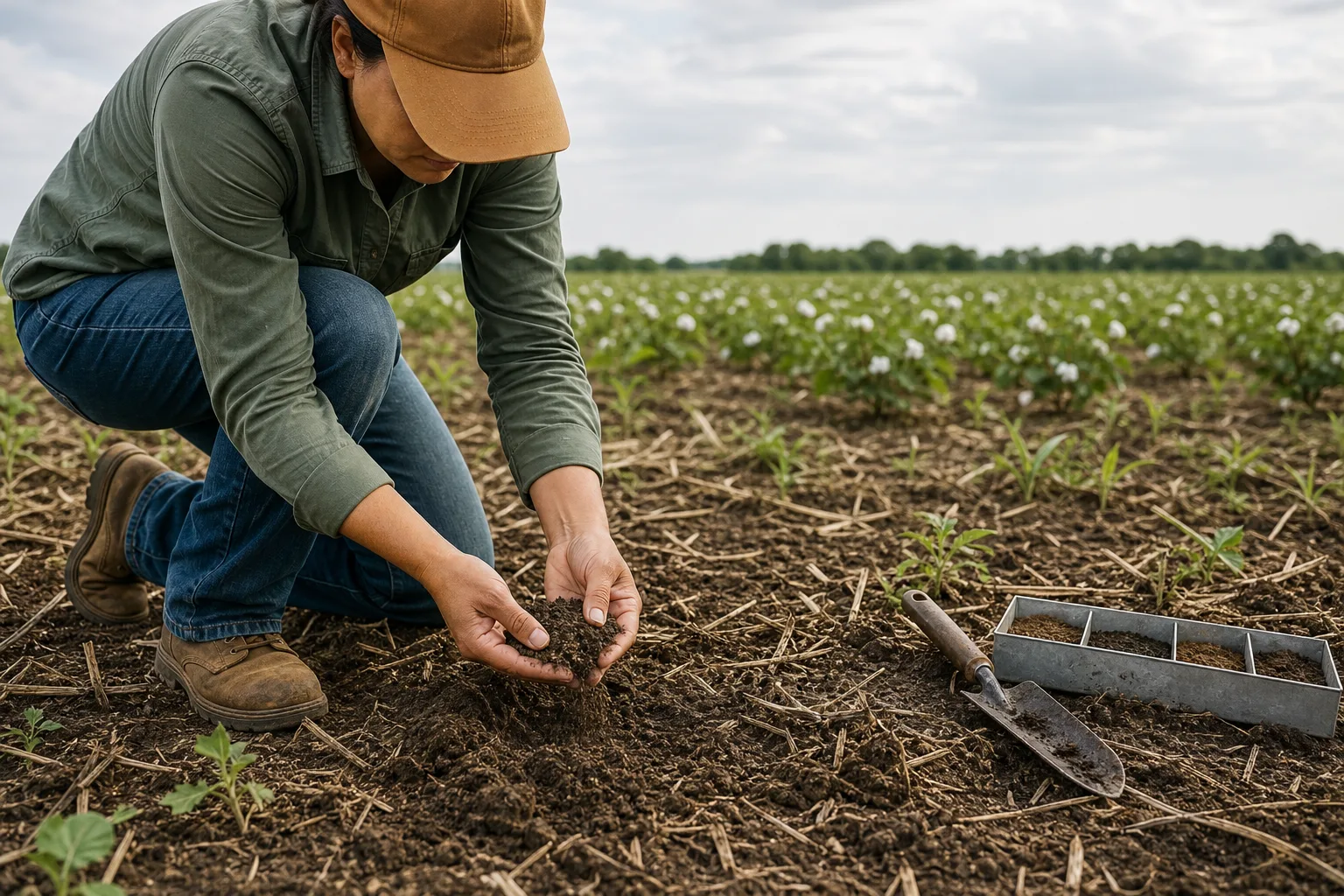
Cotton farming soil health describes how well the soil performs functions such as absorbing water, cycling nutrients, supporting roots and organisms, and resisting erosion. Farmers can influence those functions through tillage, crop rotation, cover crops, residue management, nutrient planning and other locally adapted practices. However, “soil-friendly,” “regenerative” and similar wording does not by itself prove a measured improvement. A credible claim identifies the practices used, the outcomes assessed, the period covered and the standard or verification system behind it.
What soil health means in a cotton field
Soil is not simply a medium that holds cotton plants upright. It is a changing physical, chemical and biological system. Its condition affects how water enters and moves through a field, whether roots can explore the soil, how nutrients are stored and released, and how vulnerable the surface is to wind or water erosion.
The USDA Natural Resources Conservation Service defines soil health through soil function rather than a single universal score. It groups common indicators into physical, chemical and biological categories. Examples include infiltration, bulk density, aggregate stability, organic matter, pH, available nutrients, earthworms, microbial biomass and soil respiration. No one result captures the whole system.[1]
Why local context matters
A useful soil-health plan must account for soil type, rainfall, irrigation, slope, climate, crop rotation, pest pressure and available equipment. A practice that conserves moisture in one cotton-growing region may create planting, temperature or pest-management difficulties elsewhere. Results also develop at different rates: surface cover may reduce immediate exposure to erosion, while detectable changes in organic matter can require repeated measurement over several seasons.
This is why a list of approved practices is not equivalent to proof of outcomes. Practice records show what was done. Field observations and repeated measurements help show what changed.
Four principles behind healthier cropland
USDA guidance organizes cropland soil-health management around four connected principles: minimize disturbance, maximize soil cover, maximize biodiversity and maintain living roots for as much of the year as practical.[2] These principles provide a useful framework for cotton, but implementation should be adapted to the farm rather than treated as a fixed recipe.
1. Minimize unnecessary disturbance
Repeated or intensive tillage can break soil aggregates, expose organic matter to faster decomposition and leave the surface more susceptible to erosion. Reduced-till, strip-till and no-till systems limit disturbance to different degrees. They may also reduce machinery passes, although farmers still have to manage weeds, residues, compaction and planting conditions.
“No-till” should not be read as “no impact,” and reduced tillage alone does not establish that soil health improved. The outcome depends on the wider cropping system, soil cover, traffic, nutrient management and conditions over time.
2. Keep the soil covered
Crop residue, living mulches and cover crops can shield soil from raindrop impact and wind. Cover crops grown between cash crops may also add roots, retain nutrients, suppress some weeds and improve infiltration. USDA notes that effects depend on species choice, establishment, biomass and termination management.[3]
Cover crops are therefore a management tool, not an automatic outcome claim. Seed, labor, water availability, equipment, termination timing and the risk of competition with the following cotton crop all need consideration.
3. Increase biological and crop diversity
Continuous cotton offers less plant diversity than a planned rotation. Rotating cotton with crops that have different rooting patterns, nutrient demands and pest relationships can interrupt some pest cycles and diversify the residues entering the soil. Multi-species cover crops may add further diversity, but a more complex mix is not necessarily better unless its species match the field’s needs.
4. Extend the period with living roots
Living roots supply compounds that support organisms in the root zone. Cotton fields are commonly bare or dominated by non-living residue outside the cash-crop season, so a suitable cover crop can extend the period of root activity. Whether that is practical depends on water, climate, planting windows and the surrounding rotation.
Practices and the outcomes they may support
The table separates management actions from possible outcomes. The wording is deliberately conditional: field evidence is needed before turning a possible benefit into a farm-specific claim.
| Practice or decision | Potential soil-health purpose | Evidence to look for | Important qualification |
|---|---|---|---|
| Reduced tillage or no-till | Limit aggregate disruption, erosion exposure and machinery disturbance | Tillage records, erosion observations, infiltration or aggregate-stability trends | May require different weed, residue and compaction management |
| Cover crops | Protect the surface, add roots and residues, retain nutrients or suppress weeds | Species and seeding records, ground-cover percentage, biomass, infiltration and erosion observations | Benefits and trade-offs depend on establishment, water and termination |
| Crop rotation | Increase diversity and interrupt some pest or disease cycles | Multi-year field histories, pest records, soil-test trends and rotation plans | A rotation’s value depends on the crops selected and local agronomy |
| Residue retention | Reduce bare-soil exposure and provide organic inputs | Residue-cover estimates and erosion or moisture observations | Residue can affect planting, temperature and pest management |
| Nutrient management | Match crop needs while limiting avoidable loss or imbalance | Soil and tissue tests, application records, yield maps and nutrient budgets | Application rate alone does not show nutrient-use efficiency |
| Controlled field traffic | Reduce compaction outside designated traffic lanes | Traffic maps, bulk-density or penetration measurements, root observations | Equipment compatibility and soil moisture at field entry matter |
How soil-health progress can be measured
Soil health cannot be measured directly with one definitive test. USDA recommends combining indicators and interpreting patterns across time or between comparable areas.[1] A responsible monitoring plan records sampling depth, location, season, laboratory method and field conditions so that later results are meaningfully comparable.
Physical indicators
- Water infiltration: how quickly water enters the soil under the test conditions.
- Bulk density or penetration resistance: evidence relevant to compaction and root restriction.
- Aggregate stability: how well groups of soil particles resist breaking apart.
- Ground cover and visible erosion: practical observations of surface protection and soil movement.
Chemical indicators
- Soil organic matter or soil carbon: useful for tracking part of the soil system, but affected by depth, method, soil type and sampling variability.
- pH and electrical conductivity: conditions that influence nutrient availability and plant or microbial activity.
- Nitrogen, phosphorus, potassium and other nutrients: interpreted against crop needs, soil characteristics and loss risks.
Biological indicators
- Soil respiration and microbial biomass: indicators of biological activity, not stand-alone proof that the whole system is healthy.
- Earthworms and other organisms: potentially useful observations where those organisms are expected under local conditions.
- Active or particulate organic matter: fractions that may respond to management sooner than total organic matter.
Single-year comparisons deserve caution. Weather, sampling position and crop stage can produce variation unrelated to a lasting management effect. Stronger evidence uses a documented baseline, consistent methods, repeated sampling and interpretation by qualified agronomic or soil specialists.
Soil health is not the same as cotton fiber quality
Farm conditions can influence cotton growth, and severe water stress or nutrient deficiency can affect fiber development. Even so, a soil-health claim does not tell a mill or consumer the measured length, strength, maturity, color or cleanliness of a cotton lot. Those are separate questions requiring fiber data.
USDA cotton classification uses bale-specific measurements including fiber length, length uniformity, strength, micronaire, color and trash, together with classer determinations for leaf and extraneous matter.[4] CottonWorks likewise explains that fiber properties are evaluated using standardized instruments and that variety, growing environment, crop management, harvesting and processing can all contribute to the result.[5]
Accordingly, cotton from a farm using thoughtful soil practices is not automatically softer, stronger or more durable as a finished textile. Product performance also depends on fiber selection, yarn spinning, fabric construction, finishing, garment or household-textile design, use and care. Learn more about measurable raw-cotton properties in the cotton quality guide and about how fiber becomes fabric in the cotton supply chain.
How to assess standards, labels and sourcing claims
Some cotton programs include soil-management requirements. For example, Better Cotton’s published principles describe regenerative practices such as maximizing crop diversity, minimizing soil disturbance and maximizing soil cover.[6] Such a framework can provide defined requirements and an assurance structure, but buyers should still check exactly what a claim covers.
A certification or program label may address farming practices, management systems, chain of custody, environmental outcomes or a combination of these. It should not be assumed to guarantee a particular soil-carbon gain, fiber grade or finished-product lifespan unless those results are explicitly measured and covered by the claim.
Practical claim-checking checklist
- Define the term. Does the seller explain what “regenerative,” “soil positive” or “responsibly grown” means?
- Identify the scope. Does the claim apply to a specific farm, a producer group, purchased credits, a sourcing program or the physical cotton in the product?
- Separate practices from outcomes. Is the evidence a list of actions, measured field changes or both?
- Ask for a baseline. What was measured before the claimed improvement, and when?
- Check the indicators. Were physical, chemical and biological indicators considered, or only one convenient metric?
- Look for repeated measurements. Are methods, depths, seasons and sampling locations comparable?
- Review assurance. Is the information self-declared, independently audited or certified under a named standard?
- Avoid quality substitution. Do not interpret a farming claim as evidence of fiber strength, fabric durability, softness or colorfastness.
- Consider product longevity. Construction, repairability and appropriate washing practices affect how long a cotton product remains useful.
Consumers may not receive field-level datasets for an individual shirt or sheet. In that case, a better choice is a specific, traceable statement with a clearly defined program and accessible requirements—not the most ambitious-sounding phrase. Industry buyers can request more detailed farm-group records, assurance documentation and fiber specifications.
Making better decisions without overstating the evidence
Soil-health practices can be valuable parts of cotton production, but their effects are not identical across farms or seasons. The strongest claims connect local objectives with documented practices and repeated indicators. They also acknowledge trade-offs, sampling uncertainty and the time required for change.
For product selection, keep sustainability evidence separate from textile performance evidence. Evaluate soil claims through sourcing scope and field measurement; evaluate fiber through classification data; evaluate fabric through yarn, construction and finishing; and evaluate useful life through design and care. This layered approach is more informative than treating any single marketing term as a complete measure of cotton quality or environmental performance. Continue with the cotton sustainability hub, the organic versus regular cotton guide and the certification buying guide.
Frequently asked questions
What does soil health mean in cotton farming?
It means the soil can continue to perform functions such as absorbing and storing water, cycling nutrients, supporting roots and soil organisms, and resisting erosion. It is assessed through a combination of physical, chemical and biological indicators.
Do cover crops always improve soil health in cotton fields?
Not automatically. Cover crops can protect soil, add living roots and retain nutrients, but results depend on species, establishment, water availability, biomass, termination timing and the needs of the following cotton crop.
Does healthier soil produce better-quality cotton fabric?
It may support crop growth, but it does not guarantee a particular fiber or fabric result. Fiber quality requires measurements such as length, strength and micronaire, while fabric performance also depends on yarn, construction, finishing, product design and care.
Is regenerative cotton a measurable quality grade?
No. Regenerative is generally a farming or sourcing description, not a standardized fiber-quality grade. Check how the term is defined, which practices or outcomes are covered, and whether the claim is independently verified.
What evidence supports a credible cotton soil-health claim?
Useful evidence includes a documented baseline, field histories, clearly defined practices, consistent sampling methods, repeated measurements and relevant physical, chemical and biological indicators. The claim should also state its farm and supply-chain scope.
How this guide was prepared
This page is based on desk research conducted on October 10, 2026 using published USDA soil-health and cotton-classing guidance, Better Cotton’s public principles, and CottonWorks technical fiber-quality material. No farm visits, soil or fiber tests, product trials, supplier interviews or first-hand certification audits were conducted.
Sources and scope
- Soil Health AssessmentUSDA Natural Resources Conservation Service
Explains why soil health is assessed through multiple physical, chemical and biological indicators rather than one direct measurement.
Accessed 2026-10-10 - Soil Health on CroplandUSDA Natural Resources Conservation Service
Provides the four cropland soil-health principles and context for reduced disturbance, soil cover, biodiversity and living roots.
Accessed 2026-10-10 - Cover Crops for Soil HealthUSDA Natural Resources Conservation Service
Describes the purposes, potential benefits and management requirements of cover crops.
Accessed 2026-10-10 - Cotton Classing ServicesUSDA Agricultural Marketing Service
Identifies the standardized fiber properties measured in USDA cotton classification and distinguishes fiber data from farming claims.
Accessed 2026-10-10 - Cotton Fiber QualityCottonWorks by Cotton Incorporated
Explains cotton fiber-quality measurements and the roles of variety, growing conditions, management and processing.
Accessed 2026-10-10 - Defining ‘Better’: Our Principles and CriteriaBetter Cotton
Provides an example of a cotton standard framework addressing soil health, regenerative practices and field-level sustainability.
Accessed 2026-10-10
Questions & discussion
Share a question or a useful experience about this guide. Comments appear immediately. Your name and comment are public. Email is optional and stays private; reply emails are not enabled yet. Comment privacy.