
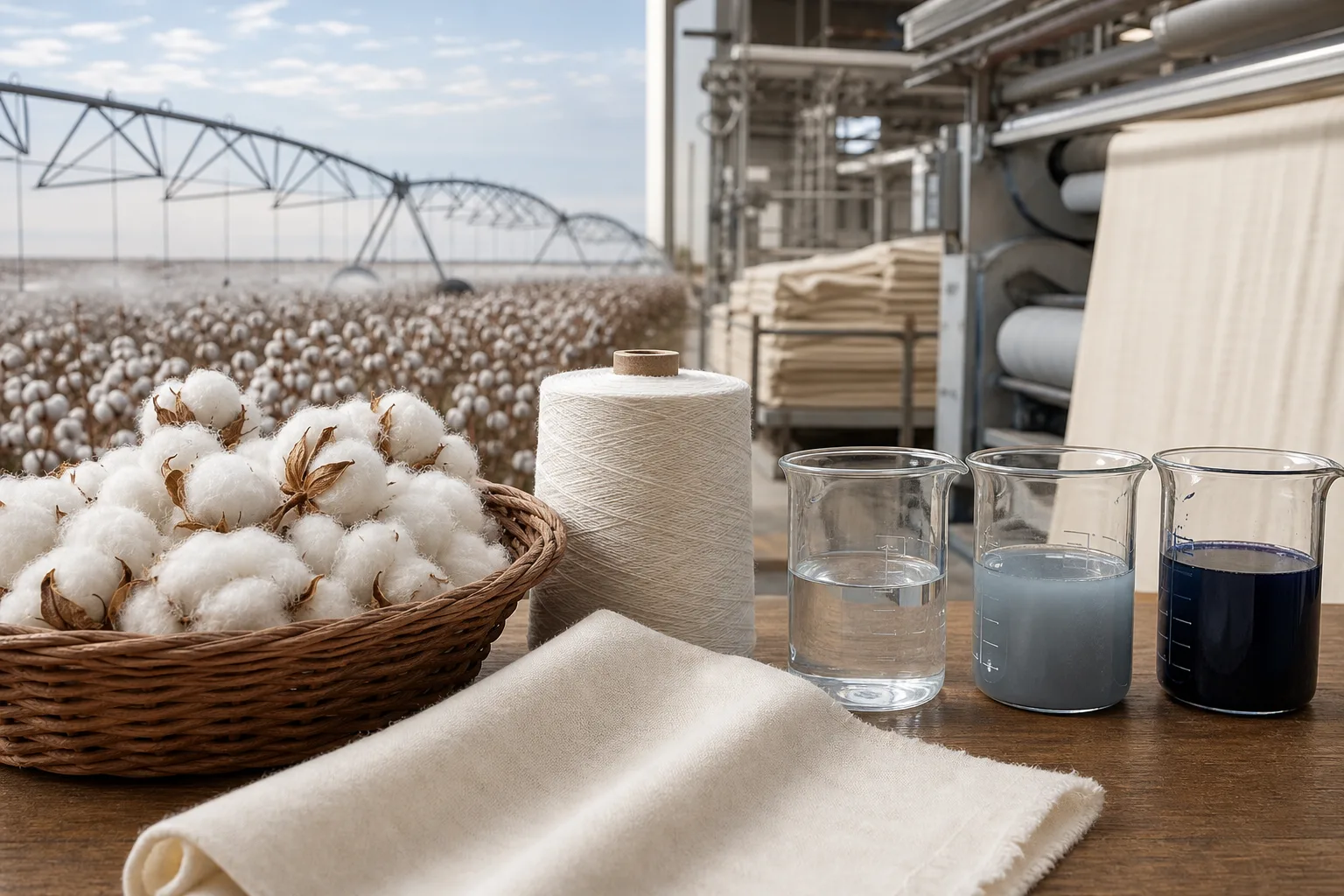
Cotton water use cannot be described responsibly with one universal number. The result changes with climate, rainfall, soil, irrigation, yield, location and the accounting method used. It also matters whether a figure covers cotton farming alone or includes spinning, fabric production, dyeing, finishing, consumer washing and disposal. For a useful comparison, look for separate reporting of rainwater and irrigation, a clearly defined boundary and evidence that accounts for local water scarcity.
The short answer: cotton uses both rainwater and irrigation
A cotton plant takes up water from the soil and releases much of it through transpiration. Water also evaporates from the field. Together, these flows are called evapotranspiration. The soil moisture may come from rainfall, irrigation or water stored before the growing season.
Some cotton is predominantly rainfed. Other cotton depends on supplemental or regular irrigation, particularly where rainfall is insufficient or poorly timed. An International Cotton Advisory Committee analysis covering 2020–2024 estimated that 44% of global cotton area was irrigated. Its modeled global averages attributed most consumptive crop water use to effective rainfall, but country results varied substantially. These are broad estimates, not product-specific measurements.[1]
This distinction is important because counting rainfall and pumped groundwater as if they created identical pressures can hide the issue that buyers usually need to understand: whether cotton production is consuming scarce surface water or groundwater in a particular catchment.
Four water terms that should not be confused
- Green water: rainfall stored in the soil and used by the crop.
- Blue water withdrawal: surface water or groundwater removed for irrigation or another process.
- Blue water consumption: withdrawn water that is not returned to the same watershed, commonly because it evaporates or is incorporated into a product.
- Water-scarcity impact: an assessment of the potential consequences of consumption in its local watershed context.
CottonWorks makes the same distinction in its U.S. cotton life-cycle assessment. It reports blue-water withdrawal, blue-water consumption and an AWARE scarcity indicator, while warning that these measures are not interchangeable with a complete water footprint.[2]
Why cotton water-use figures vary so widely
Geography and season change the result
A kilogram of lint grown during a favorable rainy season can have a different irrigation requirement from the same mass grown in an arid area. Temperature, wind, humidity and the timing of rainfall affect crop demand. Soil depth, drainage and water-holding capacity affect how much moisture remains available to roots.
Yield also changes a per-kilogram result. If two farms consume similar water volumes per hectare but one produces more usable lint, its water use per kilogram will be lower. That ratio is often called crop water productivity. It is useful, but it does not reveal whether the water came from sustainable rainfall, an overdrawn aquifer or a stressed river.
Withdrawal is not the same as consumption
An irrigation system may withdraw more water than the crop consumes. Some water can run off, drain below the root zone or return to a watershed. Those losses are not automatically harmless: their effects depend on water quality, timing and whether the returned water remains available to other users. A claim must therefore identify whether it reports water applied, water withdrawn or consumptive use.
The assessment boundary can stop at different points
A farm-gate or gin-gate study does not measure the complete water demand of a finished shirt, towel or sheet. For example, the CottonWorks U.S. cotton assessment covers agricultural inputs, farming, transport to the gin and ginning. It explicitly excludes spinning, knitting, weaving, dyeing, finishing, garment manufacture, consumer use and end of life.[2]
That limitation is not a flaw when it is disclosed. It becomes a problem only when a farm-stage result is presented as though it describes the entire product. See the cotton supply chain guide for the stages between field and finished textile.
What better water management looks like on farms
Good water management is not simply a choice between irrigated and rainfed cotton. Rainfed crops can experience drought and low yields, while well-managed irrigation can stabilize production. Conversely, irrigation can contribute to depleted rivers or aquifers when withdrawals exceed replenishment.
Useful farm-level strategies may include:
- matching irrigation timing and volume to crop growth stage, weather and measured soil moisture;
- maintaining soil structure and ground cover where locally appropriate so rainfall can infiltrate and remain available to roots;
- reducing avoidable runoff, leakage and deep percolation;
- selecting suitable irrigation delivery systems and maintaining them correctly;
- monitoring salinity, drainage and water quality rather than focusing only on volume;
- measuring yield alongside water consumption to track crop water productivity; and
- working at watershed level where multiple farms, communities and ecosystems depend on the same source.
A USDA-hosted review found that U.S. cotton crop water productivity improved over four decades through a combination of higher yields, shifts in growing regions, improved water-delivery systems, irrigation scheduling, genetics and crop modeling. The authors also identified room for further adoption of advanced scheduling technologies.[3] This is evidence of change in a particular national system, not proof that every farm or cotton product has the same result.
Farm standards can provide a management framework. Better Cotton's current Principles and Criteria require participating producers to address natural resources, including responsible water use. A program requirement can indicate which practices and assurance processes apply, but buyers should still check whether a specific water outcome was measured for the relevant crop, region and period.[4]
How to evaluate cotton water claims
Terms such as water efficient, responsibly grown or sustainable cotton are not measurements by themselves. Neither fiber length, yarn type, thread count nor fabric construction reveals how much irrigation water was consumed on the farm. Those features may affect textile quality and service life, but they are different questions.
The U.S. Federal Trade Commission advises marketers to qualify broad environmental claims and support them with competent, reliable evidence. A certification seal does not remove the responsibility to substantiate the specific express and implied claims made about a product.[5]
| Claim or information | What to ask | Stronger evidence |
|---|---|---|
| Uses less water | Less than what, by how much and during which years? | A stated baseline, percentage, geography, functional unit and calculation method. |
| Rainfed cotton | Was irrigation completely absent, or only supplemental? | Farm or regional records defining the crop season and water sources. |
| Low water footprint | Does the figure include green, blue or grey water? | Methodology, system boundary, source data and separate water components. |
| Water responsible | Does this refer to farm practices, measured outcomes or both? | A named standard plus current assurance information and outcome data where available. |
| Water-saving fabric | Is the saving from farming, dyeing, finishing or consumer care? | Stage-specific measurements against a comparable process or product. |
| Certified cotton | What does the certification cover, and how is material traced? | A public standard, valid scope, assurance model and chain-of-custody explanation. |
An organic or other preferred-cotton label should therefore be read according to its actual scope. Do not convert a production standard into a fixed water-saving percentage unless the program or supplier provides suitable water data. For further label questions, see cotton certifications explained and the organic versus conventional cotton guide.
Farm water is only part of a cotton product's story
Wet processing needs separate evidence
Scouring, bleaching, dyeing, printing and finishing can use water after the fiber leaves the farm. The amount and impact depend on process design, color, chemistry, reuse, wastewater treatment and local conditions. A low farm-stage irrigation result does not prove that a finished textile was processed with little water, just as efficient dyeing does not describe agricultural water use.
Brands and manufacturers should keep these datasets separate before combining them in a product assessment. They should also distinguish water volume from water quality. Wastewater treatment and chemical controls address different risks from freshwater consumption, even though the issues interact.
Fiber properties and construction answer different questions
Cotton's moisture absorption, yarn structure, fabric mass and weave or knit can affect comfort, drying time and care. They do not provide a direct measure of farm water use. Likewise, a high thread count or a premium cotton name is not evidence of better water management.
Construction and workmanship do matter when they help a product remain useful. Review how to assess cotton quality and the science of abrasion resistance, but keep durability evidence separate from agricultural claims.
Better choices for consumers and industry buyers
A practical purchasing checklist
- Identify the claim's scope. Determine whether it covers farming, ginning, textile processing, the finished product or its full life cycle.
- Ask where the cotton was grown. Country-level information is a start; a region or watershed provides better context.
- Separate rainfall from irrigation. Prefer reporting that identifies green and blue water rather than presenting only one total.
- Check the metric. Confirm whether the number means water applied, withdrawn, consumed or adjusted for scarcity.
- Look for a comparison baseline. A reduction claim needs a comparable earlier period, method and product or production system.
- Review the standard's scope. Establish what a certification requires, how compliance is checked and whether the physical cotton is traceable.
- Do not substitute quality language for water evidence. Staple length, yarn method, fabric construction and finishing are not farm-water metrics.
- Consider useful life and care. Choose an appropriate, well-made product and follow care instructions rather than relying on a single headline sustainability claim.
Care without unsupported promises
Consumers cannot change how an existing product's cotton was irrigated, but they can avoid unnecessary laundry and premature replacement. Wash when needed, use an appropriate load and cycle, follow the label and avoid overdrying. The best routine depends on hygiene needs, garment construction, color, finish and available equipment. See the guides to washing cotton and drying cotton for practical care decisions.
The sound conclusion is not that all cotton is water intensive or that all cotton is water efficient. Cotton water use is a location- and method-dependent issue. Better decisions come from transparent boundaries, separate rainwater and irrigation data, local scarcity context, credible assurance and realistic attention to processing, durability and care. Explore the broader cotton sustainability hub for related evidence guides.
Frequently asked questions
How much water does it take to produce cotton?
There is no universally valid figure. Results depend on location, weather, soil, yield, rainfall, irrigation and the assessment method. Check whether a number reports rainfall, irrigation withdrawal, consumptive use or scarcity-weighted impact, and whether it covers farming alone or later textile stages.
Is rainfed cotton always better than irrigated cotton?
No. Rainfed production avoids or limits irrigation withdrawals, but outcomes still depend on rainfall, soil, yield and land management. Irrigation can support stable yields, yet it creates greater concern where rivers or aquifers are already stressed. Local watershed context is essential.
Does organic cotton automatically use less water?
An organic label describes compliance with a defined production standard; it does not by itself establish a fixed water-use result. A water-saving claim still needs comparable data identifying the location, crop period, metric, boundary and baseline.
What should I look for in a cotton water-saving claim?
Look for the production region, water source, measurement period, functional unit, assessment boundary, baseline and method. The supplier should distinguish water applied, withdrawn and consumed and explain whether local scarcity and textile processing are included.
How this guide was prepared
This page is based on desk research of official and technical materials from Cotton Incorporated's CottonWorks platform, the International Cotton Advisory Committee, USDA Agricultural Research Service, Better Cotton and the U.S. Federal Trade Commission. It includes no farm visits, laboratory testing, product trials, supplier audits or first-hand certification assessment. Global and national figures are presented with their geographic, methodological and supply-chain scope limits.
Sources and scope
- Water Footprint in Cotton 2020–2024: A Global AnalysisInternational Cotton Advisory Committee
Global modeled estimates for irrigated cotton area, effective rainfall, evapotranspiration, irrigation and green and blue consumptive water; also documents assumptions and geographic variation.
Accessed 2026-10-10 - Life Cycle Assessment of U.S. Cotton Fiber ProductionCottonWorks, Cotton Incorporated
Definitions of blue-water withdrawal, blue-water consumption, water footprint and AWARE scarcity impacts; LCA boundaries, intended uses and comparison limitations.
Accessed 2026-10-10 - Forty Years of Increasing Cotton's Water Productivity and Why the Trend Will ContinueUSDA Agricultural Research Service, hosted publication from Applied Engineering in Agriculture
Review of U.S. cotton crop water productivity and the roles of irrigation delivery, scheduling, regional change, genetics and crop modeling.
Accessed 2026-10-10 - Defining BCI Cotton: Our Principles and CriteriaBetter Cotton Initiative
Current overview of Better Cotton producer requirements and the standard's coverage of natural resources and responsible water use.
Accessed 2026-10-10 - Environmental Claims: Summary of the Green GuidesFederal Trade Commission
Guidance on substantiating environmental claims, qualifying broad claims and explaining the basis of certifications and seals.
Accessed 2026-10-10
Questions & discussion
Share a question or a useful experience about this guide. Comments appear immediately. Your name and comment are public. Email is optional and stays private; reply emails are not enabled yet. Comment privacy.