
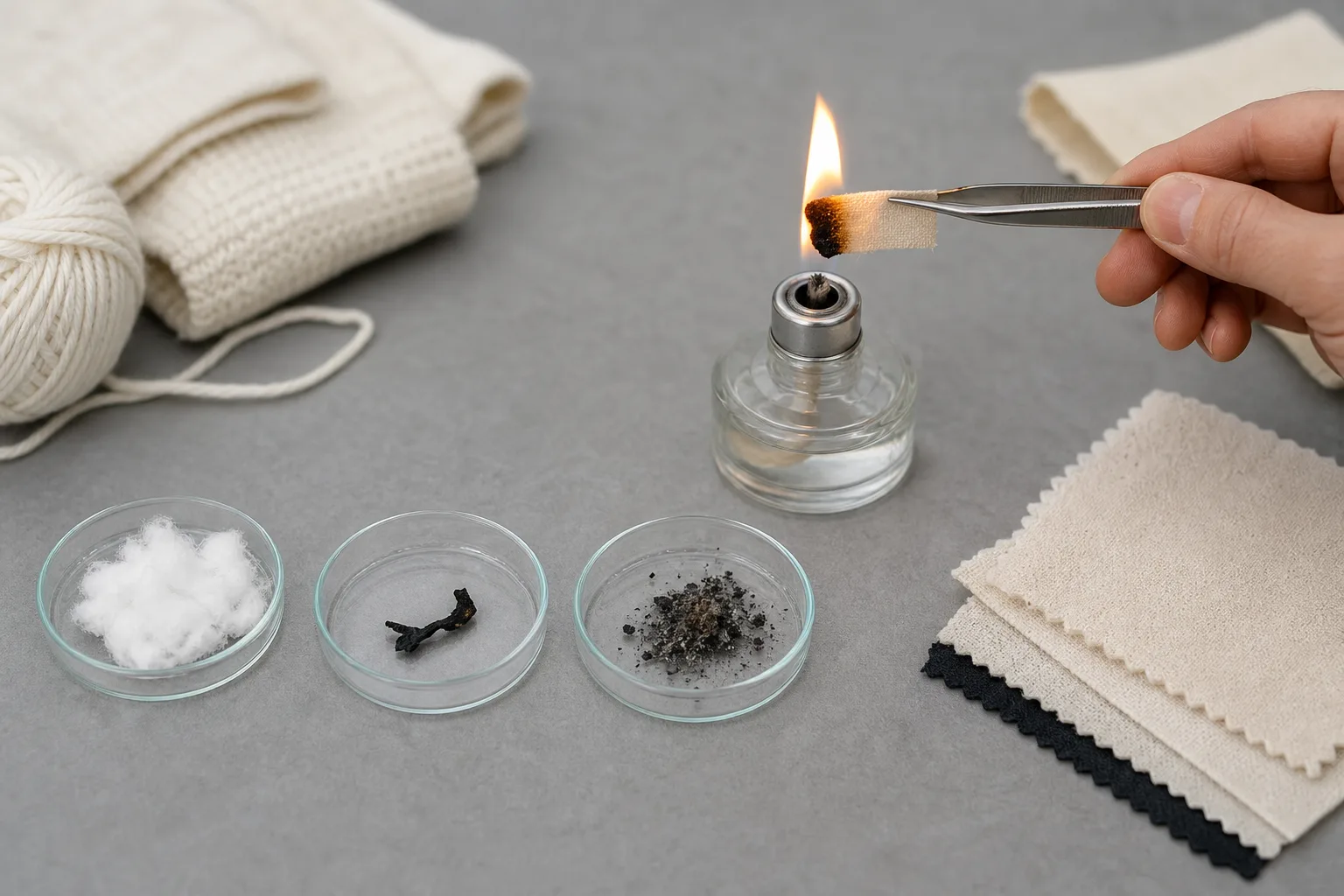
A cotton burn test is a quick, destructive screening method that observes how a few threads react to a flame. Typical cotton ignites readily, burns with an odor resembling burning paper and leaves a soft, fine gray ash rather than a hard, glassy bead. However, linen, rayon and other cellulosic fibers can behave similarly. Treat the result as an indication of fiber family—not proof that a product is 100% cotton, high quality, organic, sustainably produced or correctly labeled.
What a cotton burn test can tell you
The test can help distinguish broadly between a cellulosic material, a protein fiber and a melt-forming synthetic. Cotton is composed primarily of cellulose. A CottonWorks technical fiber guide reports that cotton leaves fine gray ash and no glassy bead when ignited. Historical National Bureau of Standards guidance similarly groups cotton with flax and certain rayon fibers because they burn with a paper-like odor and leave ash that drops away. See the CottonWorks textile fiber guide and NIST's historical fiber-identification guidance.
These shared reactions create the test's main limitation: a result consistent with cotton is also consistent with several other cellulose-based fibers. A burn test may support or challenge a label, but it does not replace documented supply-chain evidence or laboratory analysis.
Questions the test may help answer
- Does the sample burn and form ash like a cellulosic textile?
- Does it melt or form a hard bead, suggesting a thermoplastic component?
- Does the behavior appear mixed, as may occur in a blend?
- Is the observed reaction broadly compatible with the fiber-content label?
Claims it cannot verify
- The exact percentage of cotton in a blend
- Whether a cellulosic sample is cotton rather than linen, rayon or another similar fiber
- Cotton type or origin, such as Pima, Egyptian, Upland or Sea Island cotton
- Staple length, maturity, strength, micronaire or yarn quality
- Organic status, environmental impact, labor conditions or certification
- Product safety, legal flammability compliance or flame resistance
How to perform the test more safely
Only test a loose, replaceable sample. Never apply a flame to a garment while it is being worn, to fabric attached to furniture, or to an item near stored fuel, aerosols, solvents or other combustible materials. Some melting synthetic fibers can drip and cause severe burns.
What you need
- A few loose threads or a very small fabric clipping
- Long metal tweezers or locking forceps
- A noncombustible ceramic or metal dish
- A small flame source
- Water and an appropriate fire extinguisher within reach
- A ventilated, uncluttered work area away from children and pets
Step-by-step method
- Check the label first. Record the stated fiber percentages and note separate shell, lining, pile, backing, trim or elastic components.
- Isolate one component. Pull threads from a hidden seam allowance when possible. Do not combine the outer fabric with sewing thread, labels, coatings or elastic.
- Place the dish below the sample. Hold the threads with long metal tweezers over the dish, keeping hands and clothing away from the flame.
- Approach the flame slowly. Observe whether the sample shrinks, curls or melts before touching the flame.
- Expose it only briefly. Note how readily it ignites, whether it continues burning after removal, and whether it glows.
- Extinguish the sample. Do not allow a larger clipping to burn completely merely to obtain a clearer result.
- Let the residue cool. Then assess whether it is soft ash, a brittle char or a hard bead.
- Repeat only if necessary. Test a separate thread from another part when the construction may contain multiple yarn types.
Do not deliberately inhale smoke. Avoid testing textiles that may carry unknown chemical contamination, heavy finishes or flame-retardant treatments. If the item's value, composition or regulatory status matters, preserve it and use a qualified textile laboratory instead.
How to interpret cotton burn test results
Use several observations together. Odor alone is subjective, while residue alone may be affected by dyes, finishes or contamination. The following table is a practical screening guide, not a laboratory identification standard.
| Observation | Typical cotton-compatible result | What a different result may suggest |
|---|---|---|
| Near the flame | Does not normally shrink away or melt like a thermoplastic | Rapid shrinking or melting may indicate polyester, nylon, acrylic or another melt-forming fiber |
| Ignition | Ignites readily and burns | Difficulty sustaining a flame may reflect another fiber, a treatment, moisture or construction effects |
| Odor | Similar to burning paper or dry leaves | Burning-hair odor suggests a protein fiber; a sharp chemical odor may suggest a manufactured fiber or finish |
| Afterflame and glow | May continue burning and glowing after leaving the flame | Self-extinguishing behavior is not, by itself, proof of a particular fiber |
| Residue | Soft, fine gray ash with no glassy bead | A hard bead or melted mass indicates a thermoplastic component; a dark brittle residue may indicate protein fiber or a mixed material |
Why paper-like behavior is not unique to cotton
Cotton, flax and regenerated cellulose fibers such as viscose rayon are all cellulosic. Their combustion behavior can overlap enough that a simple flame test cannot reliably separate them. A result that looks like cotton should therefore be recorded as “consistent with a cellulosic fiber,” not “confirmed cotton.”
How common blends may behave
A cotton-polyester blend may show both charring and melting. The cotton portion can form ash while the polyester portion contracts into a firmer residue or bead. The dominant behavior depends on fiber percentages, yarn arrangement and fabric structure, so the test cannot calculate blend ratios.
Products may also contain different fibers in different locations. A towel can have one fiber in the loops and another in its ground fabric, while apparel may use different shell, lining and sewing-thread materials. Test components separately and compare the result with the complete label rather than treating one thread as representative of the entire product.
Why finishes, yarn and construction affect the result
A textile is more than its fiber name. Dyes, printing binders, water-repellent treatments, wrinkle-resistant resins, softeners, flame-retardant finishes, coatings, soil, oils and laundry residues can change ignition, smoke, odor and residue. USDA research also demonstrates that processing and naturally occurring components can alter cotton's thermal and combustion behavior. These variations are one reason a consumer burn test should not be used to certify flame performance.
Yarn and fabric variables
- Yarn structure: Twist, hairiness and the arrangement of fibers affect how air and flame reach the material.
- Construction: An open knit, dense weave, pile fabric and nonwoven do not expose equivalent surface areas.
- Fabric mass: A lightweight sample may ignite and burn differently from a thick towel or fleece.
- Multiple components: Core-spun yarns, stretch yarns, sewing threads, coatings and backings can produce mixed reactions.
- Moisture and contamination: Dampness, detergent, oil or soil can distort the observation.
These factors also explain why the burn test is not a measure of overall cotton quality. Quality depends on measurable fiber attributes, yarn formation, construction, finishing and suitability for the intended use. USDA cotton classing uses standardized procedures and instruments to evaluate raw cotton properties such as color, leaf, micronaire, length, strength and length uniformity—not a consumer flame test. Review USDA cotton classing services.
Burn testing versus labels and laboratory analysis
For a finished consumer product, begin with the sewn-in fiber-content label and supporting product documentation. In the United States, the Federal Trade Commission explains that covered textile products generally must identify fibers by generic name and disclose their percentages by weight under the applicable labeling rules. A product should not be represented as 100% cotton unless its fiber content supports that statement, subject to applicable exclusions such as certain trim. Read the FTC guidance on cotton labeling.
A suspicious burn result does not automatically prove that the label is false. The tested thread might come from trim, sewing thread, a backing or another separately disclosed component. Conversely, a paper-like burn does not validate a “100% cotton” claim because rayon or linen can give a similar preliminary result.
When to seek laboratory testing
Use professional analysis when composition affects purchasing specifications, import or labeling compliance, recycling decisions, legal disputes, product development or safety. Recognized textile methods can combine microscopy, chemical separation and instrumental techniques for qualitative or quantitative fiber analysis. NIST's U.S. textile compliance guide lists distinct consensus methods for fiber identification, quantitative analysis and flammability testing, demonstrating that these are separate technical questions. Consult the NIST textile compliance guide.
- Fiber identification asks which fibers are present.
- Quantitative analysis estimates how much of each fiber is present.
- Flammability testing evaluates burning behavior under specified conditions.
- Cotton fiber testing measures properties such as length, strength, maturity-related characteristics and color.
A home cotton burn test does not perform any of these tasks with standardized conditioning, apparatus, reference materials or measurement uncertainty.
A practical decision checklist
Use this checklist before drawing a conclusion:
- Have you read the complete fiber-content label, including separate components?
- Did the sample come from the main fabric rather than thread, trim, elastic, pile or backing?
- Did it burn with a paper-like odor and leave soft gray ash without a glassy bead?
- Did any portion shrink, melt, drip or leave a hard residue?
- Could a dye, coating, finish, soil or laundry product have altered the result?
- Are you describing the result as “consistent with cellulose” rather than claiming confirmed cotton?
- Would an incorrect conclusion affect safety, compliance, price or a formal specification?
If the final answer to the last question is yes, stop at preliminary screening and obtain documented or laboratory evidence. For ordinary shopping decisions, combine the label with construction, workmanship, care information and the criteria in the cotton quality buying guide. Do not use a marketing term or one burn observation as a substitute for measurable performance.
Frequently asked questions
What does cotton smell like when it burns?
Cotton typically produces an odor resembling burning paper or dry leaves because it is a cellulosic fiber. Linen and regenerated cellulose fibers such as viscose rayon may smell similar, so odor cannot confirm cotton by itself.
What residue does cotton leave after burning?
Typical cotton leaves a soft, fine gray ash and does not form the hard, glassy bead associated with many thermoplastic fibers. Dyes, finishes, contamination and blended fibers can change the residue.
Can a burn test prove that fabric is 100% cotton?
No. It can indicate behavior consistent with a cellulosic fiber, but it cannot reliably distinguish cotton from linen or rayon, detect every minor component, or measure blend percentages. Confirm important claims through labels, documentation and appropriate laboratory analysis.
Can the burn test measure cotton quality?
No. It does not measure staple length, strength, micronaire, maturity, yarn uniformity, construction or finishing quality. Those characteristics require separate evaluation and, for technical measurements, standardized instruments or laboratory methods.
How this guide was prepared
This guide is based on desk research of CottonWorks technical material and official FTC, USDA and NIST publications accessed on October 13, 2026. No first-hand burn test, laboratory analysis, product trial, certification review or supplier inspection was conducted.
Sources and scope
- Textile FibersCottonWorks / Cotton Incorporated
Cotton's cellulosic composition, thermal properties, burn residue and the distinction between burn identification and measured cotton fiber quality.
Accessed 2026-10-13 - Circular of the Bureau of Standards No. 422: Methods of Testing HosieryNational Bureau of Standards, now NIST
The preliminary burn behavior shared by cotton, flax and certain rayon fibers, including paper-like odor and ash.
Accessed 2026-10-13 - Calling It Cotton: Labeling and Advertising Cotton ProductsFederal Trade Commission
U.S. guidance on fiber-content disclosures, 100% cotton representations, named cotton types and separately constructed textile components.
Accessed 2026-10-13 - Cotton Classing ServicesUSDA Agricultural Marketing Service
The standardized properties and procedures used to classify raw cotton, which differ from consumer fiber-identification tests.
Accessed 2026-10-13 - A Guide to United States Apparel and Household Textiles Compliance RequirementsNational Institute of Standards and Technology
The distinction among recognized methods for fiber identification, quantitative textile analysis and flammability testing.
Accessed 2026-10-13
Questions & discussion
Share a question or a useful experience about this guide. Comments appear immediately. Your name and comment are public. Email is optional and stays private; reply emails are not enabled yet. Comment privacy.