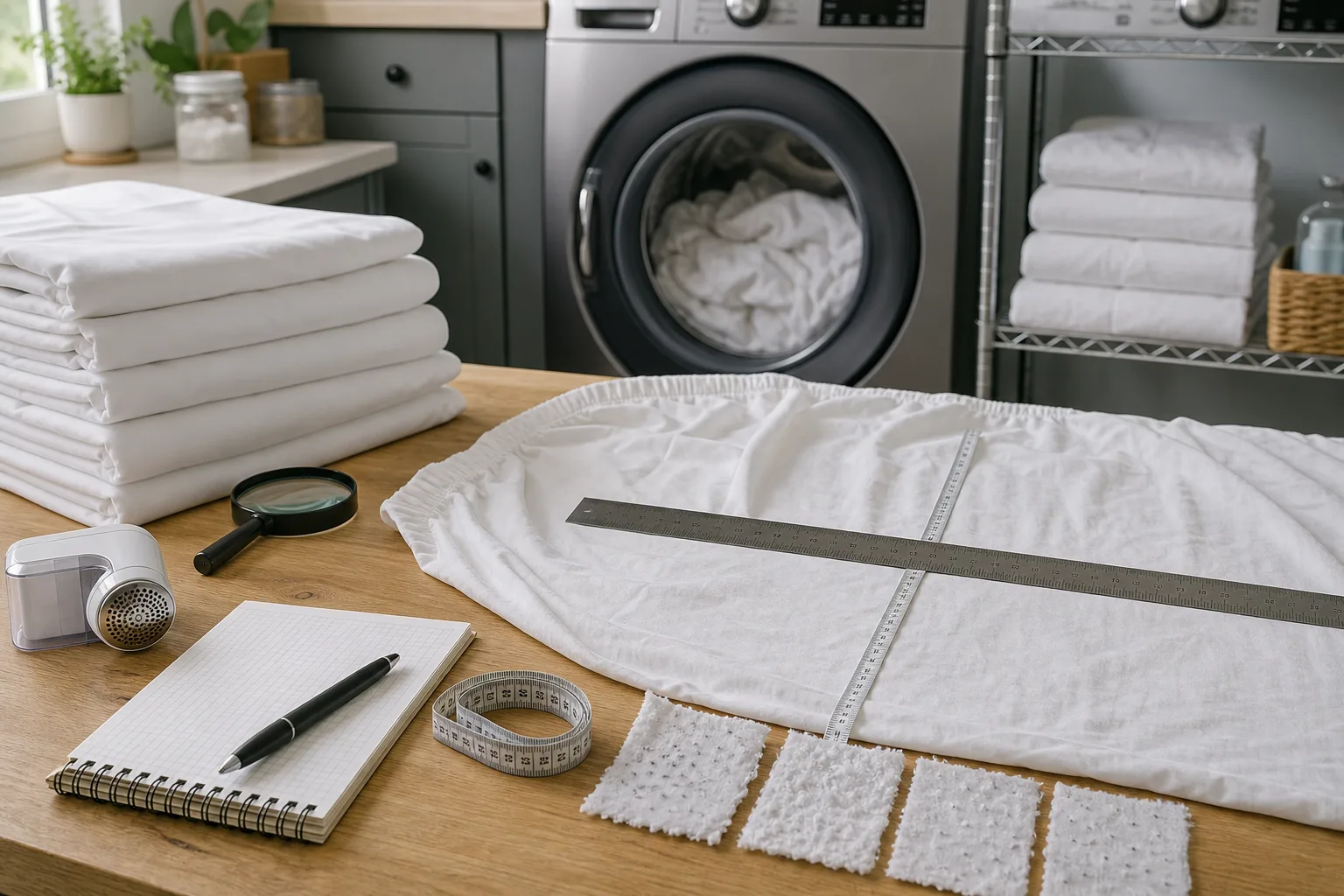
A practical cotton sheet wash test should answer three questions: Did the sheet change size, did its surface develop pills or fuzz, and does the fitted sheet still fit the same mattress? The protocol below records those outcomes at baseline and after 1, 5, 10 and 20 wash-and-dry cycles. It is designed for repeatable home comparison, not certification. Keep the care method, equipment, load and measuring technique as consistent as possible, and report observations rather than turning marketing terms into test results.
What this 20-wash protocol can measure
The test covers changes that consumers can observe and document with ordinary equipment. Dimensional change matters because excessive shrinkage or growth can affect appearance, serviceability and fit. Laundering and drying can also produce abrasion that reveals fuzzing or pilling. CottonWorks identifies fiber, yarn, construction, wet processing, finishing and care as interacting influences on shrinkage, rather than assigning performance to fiber content alone. ([cottonworks.com](https://cottonworks.com/learning-hub/quality-assurance/quality-testing/?utm_source=openai))
Primary outcomes
- Dimensional change: percentage change in sheet length and width relative to the unwashed baseline.
- Fitted-sheet fit: whether the sheet can still be installed, reaches under the mattress and remains in place.
- Pilling and fuzzing: visible changes to the fabric surface under consistent lighting.
- Construction: seam puckering, elastic distortion, twisted hems, loose stitching or other changes.
- Appearance: obvious color change, uneven fading or print deterioration, recorded descriptively rather than with a laboratory color rating.
This protocol does not measure tensile strength, abrasion resistance, colorfastness, fiber length or chemical finish content. It also cannot prove that one sheet will last a particular number of years. Laboratory methods use controlled sampling, conditioning, equipment and rating standards that a home test does not reproduce.
Do not treat the label as a performance score
Record the fiber-content label, weave description, size, stated pocket depth and care directions before testing. In the United States, bedding including sheets is covered by federal textile fiber-labeling requirements. A sheet represented as 100% cotton should therefore be evaluated as a labeled fiber product, but that disclosure does not predict its shrinkage, pilling resistance or fit retention. The FTC also explains that a named cotton type must be presented truthfully and with the required fiber disclosure. ([ftc.gov](https://www.ftc.gov/business-guidance/resources/calling-it-cotton-labeling-advertising-cotton-products-0?utm_source=openai))
Likewise, terms such as “premium,” “hotel quality,” “luxury,” “long staple,” “preshrunk” or a high thread count are not wash-test results. Sheet performance also depends on yarn formation, fabric construction, weight, finishing, sewing and the care process. Learn how to assess those distinctions in how to tell cotton quality and the thread-count comparison.
Equipment, sample selection and controls
What you need
- One new sheet or sheet set, preferably with an unused duplicate if making product-comparison claims
- A washer and the dryer or air-drying setup specified by the supplied instructions
- The same detergent for every cycle
- A flexible tape measure marked in inches and centimeters
- Removable fabric-safe markers, clips or small safety pins for measurement locations
- A flat surface larger than the item being measured
- A camera, consistent lighting and a plain background
- A cycle log and calculator or spreadsheet
- The mattress used for every fitted-sheet assessment
Test each component separately in the record. Do not average a fitted sheet, flat sheet and pillowcase into one result because their dimensions, seams and exposure to friction differ. If comparing two products, wash them under equivalent conditions but check that their labels permit the same process. A comparison is not controlled if one sheet requires low heat and the other is repeatedly dried on high heat.
Hold the main variables steady
Use the same machine, program, water-temperature selection, spin setting, detergent dose, drying method and approximate load size throughout the test. Record unavoidable deviations such as a changed detergent, overloaded cycle or partial air-dry. Do not add bleach, softener, scent beads or stain treatment unless the test is specifically evaluating that product and the sheet instructions permit it.
A home washer does not necessarily deliver the exact temperature named on its control panel, and automatic programs may vary water volume or cycle duration. That uncertainty is acceptable for a practical use test if the selected settings remain consistent and are disclosed. For broader guidance, see washing cotton and drying cotton.
Establish the unwashed baseline
Do not wash the sample before recording Cycle 0. If the retailer recommends washing before first use, that first wash becomes Cycle 1 rather than part of sample preparation.
Document identity and condition
- Photograph the packaging and all attached labels.
- Record the claimed size, fiber content, weave or construction, pocket depth and care instructions.
- Note whether the fabric is woven or knitted and whether it has brushing, prints, decorative finishes or obvious surface texture.
- Inspect both faces for existing pills, fuzz, snags, missed stitches, seam puckering and color variation.
- Photograph the full item and close views of the center, foot area, hem, seam and elastic edge.
Measure without stretching
Lay the sheet flat and smooth it gently without pulling. Let strong fold creases relax before measuring. For a flat sheet, take three length measurements—near each side and through the center—and three width measurements at the top, middle and bottom. Average the three readings for each direction. For a fitted sheet, measure the top panel along marked lengthwise and widthwise lines. Also record the pocket depth from the top seam to the lower elastic edge without extending the elastic.
Measure the mattress length, width and depth separately. Install the fitted sheet in a fixed orientation, such as with the label at the lower-left corner. Photograph all four corners and record the baseline fit score described below. Remove the sheet and complete the flat measurements before Cycle 1.
Run and record the 20 wash cycles
Follow the supplied wash and dry directions rather than selecting a deliberately harsher treatment. If the instructions are missing or ambiguous, disclose the chosen settings and avoid presenting the result as proof that the manufacturer’s intended care process succeeds or fails.
| Stage | Required action | Record |
|---|---|---|
| Cycle 0 | Measure and photograph the unwashed sheet | Dimensions, condition, label details and fitted-sheet score |
| Cycle 1 | Complete one full wash-and-dry process | Dimensions, fit, pilling, seams and photographs |
| Cycles 2–4 | Repeat the same care process | Settings and any deviations |
| Cycle 5 | Repeat the full assessment | All dimensions and appearance scores |
| Cycles 6–9 | Continue controlled laundering | Settings, incidents and visible damage |
| Cycle 10 | Repeat the full assessment | All dimensions and appearance scores |
| Cycles 11–19 | Continue without changing the procedure | Settings, incidents and visible damage |
| Cycle 20 | Complete the final assessment | Dimensions, fit, pilling, construction and final photographs |
Count a cycle only when both the selected washing and drying stages are complete. If the care direction says to line dry, one wash followed by one complete line-dry is one cycle. Do not count a rinse-only refresh or dryer touch-up as a full cycle.
After each checkpoint cycle, allow the sheet to cool and reach a consistent dry condition before measuring. Measure it in the same orientation and at the marked locations used at baseline. Prompt dryer removal may help make handling consistent, but do not iron, stretch or block the sheet into shape unless that is part of the stated care method.
Calculate shrinkage and evaluate fit
Dimensional-change calculation
Calculate each direction separately:
Dimensional change (%) = ((measurement after washing − baseline measurement) ÷ baseline measurement) × 100
A negative result means shrinkage; a positive result means growth. For example, a baseline width of 100 inches that measures 97 inches after washing has changed by −3%. Report it as 3% width shrinkage or −3% dimensional change. Do not combine length and width into a single percentage because the directions may behave differently.
Small differences can come from tape placement, wrinkles and measuring tension. Retake any surprising measurement before recording it. For comparison testing, use the same person and technique at every checkpoint. CottonWorks notes that standardized dimensional testing controls laundering parameters; this home protocol borrows the principle of fixed conditions but is not a substitute for a recognized laboratory method. ([cottonworks.com](https://cottonworks.com/encyclopedia-item/dimensional-change/?utm_source=openai))
Fitted-sheet fit scale
- 0 — Unchanged: all corners install normally, the skirt reaches beneath the mattress and no corner lifts during the check.
- 1 — Snug: installation requires more tension than at baseline, but all corners remain secured.
- 2 — Marginal: the skirt has limited under-mattress coverage, a corner repeatedly lifts, or installation requires excessive pulling.
- 3 — No longer fits: one or more corners cannot be installed without unsafe force or immediately come off.
This score is mattress-specific. Record mattress dimensions, protectors or toppers because they affect effective depth. A sheet may fit one mattress and fail on a deeper model even if both are sold under the same nominal bed size. See fitted-sheet pocket depth after washing for a more detailed sizing method.
Score pilling and inspect construction
Pills are small entangled balls of fiber attached to the surface. Pilling can become visible during laundering, but susceptibility is influenced by fiber or blend, fiber dimensions, yarn and fabric construction, finishing and end use. It should not automatically be attributed to “cotton” as a fiber or to consumer error. ([cottonworks.com](https://cottonworks.com/encyclopedia-item/pilling/?utm_source=openai))
Practical surface rating
- 0 — None: no visible pills and no meaningful change from baseline.
- 1 — Slight fuzzing: raised fibers are visible under close inspection, with few or no formed pills.
- 2 — Light pilling: scattered small pills are visible in the inspection photographs.
- 3 — Moderate pilling: pills are easy to see across several assessed areas.
- 4 — Heavy pilling: dense or widespread pills materially change the surface appearance or feel.
Rate the center, foot area, pillow contact area and edges separately before giving an overall description. Use the same light angle, camera distance and background at each checkpoint. Remove loose lint by gentle shaking only; do not shave the surface before the final assessment. Learn more about the underlying mechanism on the cotton pilling guide.
Construction checklist
- Are hems still straight, or have they twisted or puckered?
- Are stitches broken, loose or pulling away from the fabric?
- Has fitted-sheet elastic curled, hardened or lost recovery?
- Are there snags, holes or thin areas that were absent at baseline?
- Has a print faded unevenly or transferred to another area?
- Has the surface become rougher, fuzzier, smoother or thinner?
Interpret and publish the results responsibly
There is no universal home-test percentage that makes every cotton sheet a pass or fail. A practical conclusion should connect measured change to use: whether the fitted sheet still fits the documented mattress, whether the flat sheet retains adequate coverage, and whether surface or seam changes are acceptable for the intended market. Suppliers and professional buyers may set specifications, but those limits should be declared before testing rather than chosen after seeing the result.
Publish the complete care settings, baseline dimensions, checkpoint data, fit scores, photographs and deviations. State whether the sample was one purchased item or part of a larger sample. One sheet can reveal what happened to that specimen; it cannot establish manufacturing consistency across colors, sizes, batches or factories.
Keep claims within scope. A 20-wash result does not verify fiber origin, named cotton type, certification, biodegradability, labor conditions or overall sustainability. It may provide limited evidence about durability under the stated care routine, but environmental conclusions require separate information about materials, production, use and end of life. For care choices intended to reduce avoidable size change, see how to prevent cotton shrinkage.
A useful final statement is specific: “This specimen changed by X% in length and Y% in width after 20 recorded cycles, received a pilling score of Z under this visual scale, and retained or lost fit on a mattress measuring the stated dimensions.” That is more informative—and more defensible—than calling a sheet “wash-proof,” “no-shrink” or “best quality.”
Frequently asked questions
Why test cotton sheets for 20 wash cycles?
Twenty controlled cycles provide several checkpoints for observing progressive dimensional, fit and surface changes. The number is a practical protocol choice, not a universal durability standard or a prediction of product lifespan.
Does a preshrunk label mean a cotton sheet will not shrink?
No. Preshrunk describes prior processing, not a guarantee of zero dimensional change. Measure the unwashed sheet and calculate its actual length and width changes under the stated care routine.
Should cotton sheets be washed in hot water for this test?
Use the supplied care instructions. Selecting hotter water or higher dryer heat creates a different test and may not represent the manufacturer's intended care process.
Can this home test prove that one sheet is higher quality?
It can compare documented shrinkage, pilling, construction and fit under controlled home conditions. It cannot by itself verify fiber origin, laboratory durability, certification, sustainability or consistency across an entire production run.
How is fitted-sheet shrinkage measured?
Measure marked lengthwise and widthwise lines on the top panel without stretching, record pocket depth, and test the sheet on the same measured mattress at every checkpoint.
How this guide was prepared
This page is a desk-researched protocol based on CottonWorks technical guidance about dimensional stability, laundering, shrinkage and pilling, plus FTC guidance on cotton fiber labeling. No sheets were purchased, washed, measured or laboratory-tested for this article, and no product results, certifications or first-hand observations are claimed.
Review status: Publishable quality advisory.
Sources and scope
- Quality TestingCottonWorks
Explains why dimensional stability, pilling, surface appearance and consistent sampling conditions matter when evaluating textiles after laundering.
Accessed 2026-10-07 - Shrinkage & SkewingCottonWorks
Describes dimensional change and the roles of fiber, yarn, construction, wet processing, finishing and care in textile shrinkage.
Accessed 2026-10-07 - Calling It Cotton: Labeling and Advertising Cotton ProductsFederal Trade Commission
Confirms that bedding is covered by textile fiber-labeling requirements and explains truthful disclosure for cotton content and named cotton types.
Accessed 2026-10-07