
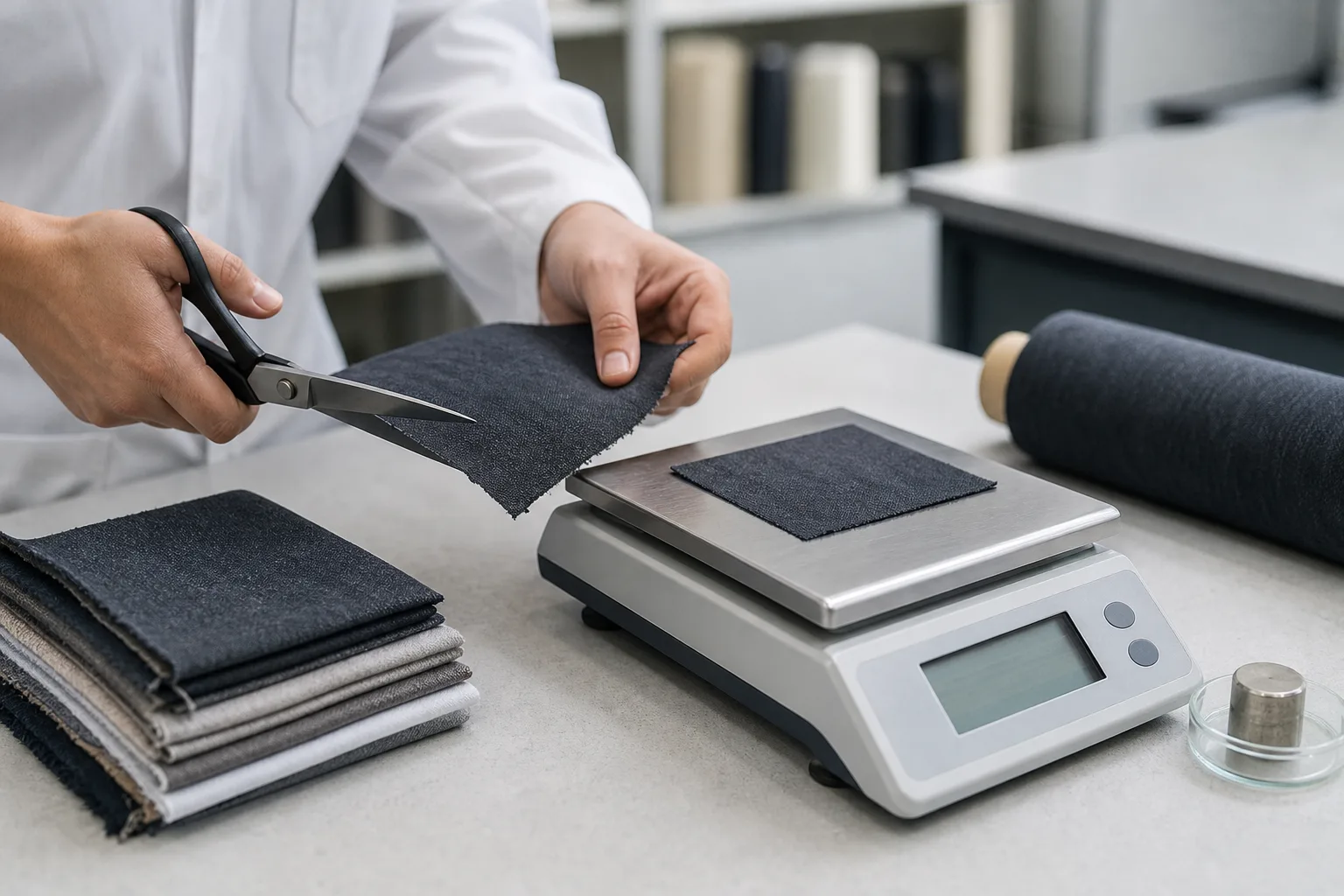
To measure fabric GSM, weigh a known area of fabric in grams, divide that mass by the area in square meters, and report the result in grams per square meter. For example, a 20 cm × 20 cm swatch has an area of 0.04 m². If it weighs 7.2 g, its estimated weight is 7.2 ÷ 0.04 = 180 GSM. This straightforward calculation can help compare fabrics, check a supplier specification or document changes after laundering, but it is not a complete test of cotton quality, durability, comfort or fiber content.
What fabric GSM measures
GSM means grams per square meter. It describes mass per unit area: how many grams one square meter of the fabric would weigh under the same conditions as the sample. It is sometimes called fabric weight, areal density or mass per unit area.
GSM applies to the fabric as tested, including its fibers, yarns, colorants, finishes and any retained moisture. The number is therefore different from cotton fiber measurements such as staple length, micronaire, strength, color and trash. USDA cotton classing evaluates those properties in raw cotton samples; it does not assign a GSM value to finished fabric. USDA Agricultural Marketing Service describes cotton classing and its measured fiber properties.
A finished fabric's weight is influenced by several interacting choices:
- Fiber content and blend proportions
- Yarn size, structure and spinning system
- Woven thread density or knitted loop structure
- Pile, brushing, napping or raised surfaces
- Dyes, resins, coatings and other finishes
- Mechanical relaxation, compaction and shrinkage
- Moisture present when the specimen is weighed
For that reason, a high or low GSM is not automatically good or bad. It is a construction specification that must be interpreted for the intended product.
How to measure fabric GSM at home or in a workroom
Equipment
- A representative fabric swatch that can be cut
- A flat ruler or measuring tape marked in millimeters
- Sharp scissors or a rotary cutter and cutting mat
- A digital scale that reads at least 0.1 g; 0.01 g is preferable for small or light specimens
- A calculator
A kitchen scale that reads only whole grams may be adequate for a large, heavy specimen, but it can create a substantial error when a small swatch weighs only a few grams. Scale display resolution is not the same as proven accuracy. NIST guidance treats repeatability, calibration and other influences as contributors to weighing uncertainty rather than assuming that every displayed digit is exact. See NIST's guide to balance and scale uncertainty.
Step-by-step method
- Let the fabric stabilize. Keep it flat in the room where it will be measured for several hours, away from steam, direct heat and unusual humidity. Do not weigh it immediately after washing, ironing or removing it from damp packaging.
- Select representative locations. Avoid seams, hems, labels and selvedges unless one of those features is specifically being evaluated. For patterned, coated or variable fabric, sample more than one location.
- Cut a precise rectangle. A 20 cm × 20 cm or larger specimen is more suitable than a tiny square when using a household scale. Keep the cut edges straight without stretching a knit.
- Measure the finished specimen. Measure its actual length and width after cutting rather than relying solely on the intended cutter setting.
- Tare the scale. Place any clean weighing container on the scale, set the display to zero, and then add the specimen.
- Record the mass in grams. Repeat the weighing at least once. If readings fluctuate, check for drafts, vibration, contact with nearby objects or an unstable scale surface.
- Calculate GSM. Apply one of the formulas below and retain the unrounded value until the final step.
- Repeat with additional specimens. Calculate each result and report the average, along with the range when variation matters.
CottonWorks notes that reliable textile testing depends on appropriate sampling and conditioning. A home or workroom method cannot reproduce all laboratory controls, but consistent handling makes comparisons more meaningful. CottonWorks provides an overview of textile quality testing and conditioning.
Fabric GSM formulas and worked examples
Metric formula
GSM = specimen mass in grams ÷ specimen area in square meters
When dimensions are measured in centimeters, use:
GSM = mass in grams × 10,000 ÷ area in cm²
For a rectangle, area in cm² equals length in centimeters multiplied by width in centimeters.
| Specimen | Measured mass | Calculation | Result |
|---|---|---|---|
| 10 cm × 10 cm | 1.8 g | 1.8 × 10,000 ÷ 100 | 180 GSM |
| 20 cm × 20 cm | 7.2 g | 7.2 × 10,000 ÷ 400 | 180 GSM |
| 25 cm × 40 cm | 18.6 g | 18.6 × 10,000 ÷ 1,000 | 186 GSM |
| 40 cm × 40 cm | 28.8 g | 28.8 × 10,000 ÷ 1,600 | 180 GSM |
The first two examples produce the same calculated GSM, but the larger specimen is generally more suitable for a low-resolution scale. On a scale that rounds to the nearest gram, a reading near 2 g carries much greater proportional uncertainty than a reading near 29 g.
Using a 100 cm² GSM cutter
A purpose-made cutter may remove a specimen with an area of exactly 100 cm². In that case:
GSM = specimen mass in grams × 100
A 100 cm² specimen weighing 2.15 g therefore equals 215 GSM. This shortcut is valid only when the cutter's actual specimen area is known and maintained. A worn blade, incomplete cut or loss of fibers from the specimen can affect the result.
Converting ounces per square yard
Fabric weight may also be listed in ounces per square yard. For practical conversion:
- GSM = oz/yd² × 33.906
- oz/yd² = GSM ÷ 33.906
For example, 6 oz/yd² is approximately 203 GSM. A converted specification does not become more precise merely because it is shown with extra decimal places.
How to reduce measurement error
The arithmetic is simple, but the result can still be misleading if the specimen or equipment is poorly controlled. Use this checklist before comparing results:
| Check | Why it matters |
|---|---|
| Use the same conditioning period | Cotton can gain or lose moisture as surrounding conditions change, altering measured mass. |
| Choose a larger specimen | A larger mass reduces the proportional effect of scale rounding. |
| Measure after cutting | Cutting errors change the actual area used in the calculation. |
| Avoid stretching knits | Stretching changes dimensions and makes the calculated area unreliable. |
| Test several locations | Fabric may vary across its width or along a roll. |
| Keep sample layers separate | Folds, trapped lint or an unnoticed second layer add mass. |
| Use consistent fabric state | Unwashed, washed, pressed and relaxed specimens may have different dimensions and GSM. |
| Report the method | Specimen size, scale resolution and fabric condition help others judge the result. |
For a useful informal report, state something such as: “Average 182 GSM from three 20 cm × 20 cm specimens, conditioned in the same room overnight and weighed on a 0.01 g scale.” This is more informative than reporting “182 GSM” without context.
Moisture deserves particular attention with cotton. CottonWorks defines moisture regain as moisture gained after a substrate has been dried and then exposed to standard laboratory conditions. Laboratory conditioning controls this influence more closely than ordinary room storage. A consumer measurement should therefore be treated as an estimate, especially when comparing results obtained in different climates or seasons.
How to interpret fabric weight
GSM is most useful when comparing fabrics intended for the same purpose and made with similar constructions. A 180 GSM single-jersey knit and a 180 GSM plain-weave fabric can feel, stretch and perform very differently. Even two cotton T-shirt fabrics at the same GSM may differ because of yarn count, twist, spinning method, stitch length, finishing and shrinkage control.
What GSM can indicate
- The amount of finished fabric mass covering a given area
- Whether samples appear consistent with an agreed weight specification
- Changes in mass per area after washing, shrinkage or application of a finish
- A useful construction variable for comparing similar fabrics
What GSM cannot establish by itself
- Cotton fiber length, strength, maturity or micronaire
- Fiber content or whether a fabric is 100% cotton
- Abrasion resistance, tensile strength, pilling resistance or seam performance
- Breathability, absorbency, opacity, softness or thermal comfort
- Whether dyes and finishes meet chemical or colorfastness requirements
- Organic, recycled, regenerative or other sustainability claims
- Overall product quality or expected service life
Fiber-content labels serve a different purpose. In the United States, the FTC Textile Fiber Rule requires covered products to disclose constituent fiber names and percentages by weight, among other information; it does not make a GSM figure a substitute for fiber identification. The FTC summarizes the Textile Fiber Rule. Treat descriptions such as “premium,” “heavyweight” or “luxury weight” as marketing language unless the seller provides a numerical specification and defines how it was measured.
Heavier fabric also should not automatically be presented as more sustainable. Higher GSM usually means more finished material per unit area, but environmental performance depends on the wider product system, including fiber production, processing, durability, care and end of life.
When laboratory testing is appropriate
A careful home measurement is suitable for education, preliminary comparisons and internal checks that do not require formal conformity. It is not equivalent to a standardized laboratory result.
Consider qualified laboratory testing when GSM is tied to purchase acceptance, production tolerances, regulatory evidence, contract disputes or repeatable comparisons among suppliers. A laboratory can use documented sampling, conditioning, cutting, balance verification and reporting procedures. It can also test related properties—such as dimensional stability, strength, pilling or air permeability—rather than assuming that fabric weight predicts them.
Before sending material for testing, define whether the requested value applies to greige fabric, finished fabric, washed fabric or a complete product. Also specify how many specimens and production lots are involved. A single swatch cannot characterize all variation within a roll, shipment or manufacturing run.
For consumer buying decisions, use GSM as one item in a broader assessment. Check the fiber label, construction, finish, care instructions and evidence for any performance or sustainability claim. For industry specifications, state the test condition and permitted tolerance rather than relying on an undefined term such as “midweight.”
Frequently asked questions
What is the formula for measuring fabric GSM?
Divide the specimen's mass in grams by its area in square meters. If measurements are in centimeters, multiply the mass by 10,000 and divide by the area in square centimeters.
Can I measure GSM without cutting the fabric?
Not reliably from a finished garment or an irregular piece. You need both an accurate fabric mass and an accurate area. Seams, hems, trims and overlapping layers make whole-product estimates unsuitable for determining the GSM of the base fabric.
Does higher GSM mean better-quality cotton?
No. GSM measures finished fabric mass per unit area, not cotton fiber quality. Fiber properties, yarn construction, fabric structure, finishing and intended use must be assessed separately.
Should fabric be measured before or after washing?
That depends on the question. Use unwashed fabric to check an as-supplied specification and washed fabric to evaluate the post-care state. Record the condition clearly because shrinkage and removal or addition of material can change GSM.
How accurate is a home GSM measurement?
It can provide a useful estimate when the specimen is large, dimensions are measured carefully and the scale has suitable resolution. It is not equivalent to a laboratory result with controlled conditioning, verified equipment and documented sampling.
How this guide was prepared
This guide is based on desk research of CottonWorks textile-testing guidance, USDA cotton-classing information, NIST weighing-uncertainty guidance and FTC textile-labeling requirements, accessed on October 14, 2026. The calculation examples are mathematical illustrations, not results from first-hand fabric tests or product trials.
Sources and scope
- Quality TestingCottonWorks
Distinguishes fiber, yarn, fabric and garment testing and explains the importance of representative sampling and conditioning for reliable textile measurements.
Accessed 2026-10-14 - Cotton Classing ServicesUSDA Agricultural Marketing Service
Identifies the raw-cotton properties measured in USDA classing and documents the controlled laboratory conditions used for consistent classification.
Accessed 2026-10-14 - Recommended Guide for Determining and Reporting Uncertainties for Balances and ScalesNational Institute of Standards and Technology
Supports the discussion of balance repeatability, measurement uncertainty and the limits of treating a displayed scale reading as exact.
Accessed 2026-10-14 - Textile Fiber RuleFederal Trade Commission
Clarifies that covered U.S. textile labels disclose constituent fiber names and percentages by weight, which is distinct from fabric GSM.
Accessed 2026-10-14
Questions & discussion
Share a question or a useful experience about this guide. Comments appear immediately. Your name and comment are public. Email is optional and stays private; reply emails are not enabled yet. Comment privacy.