
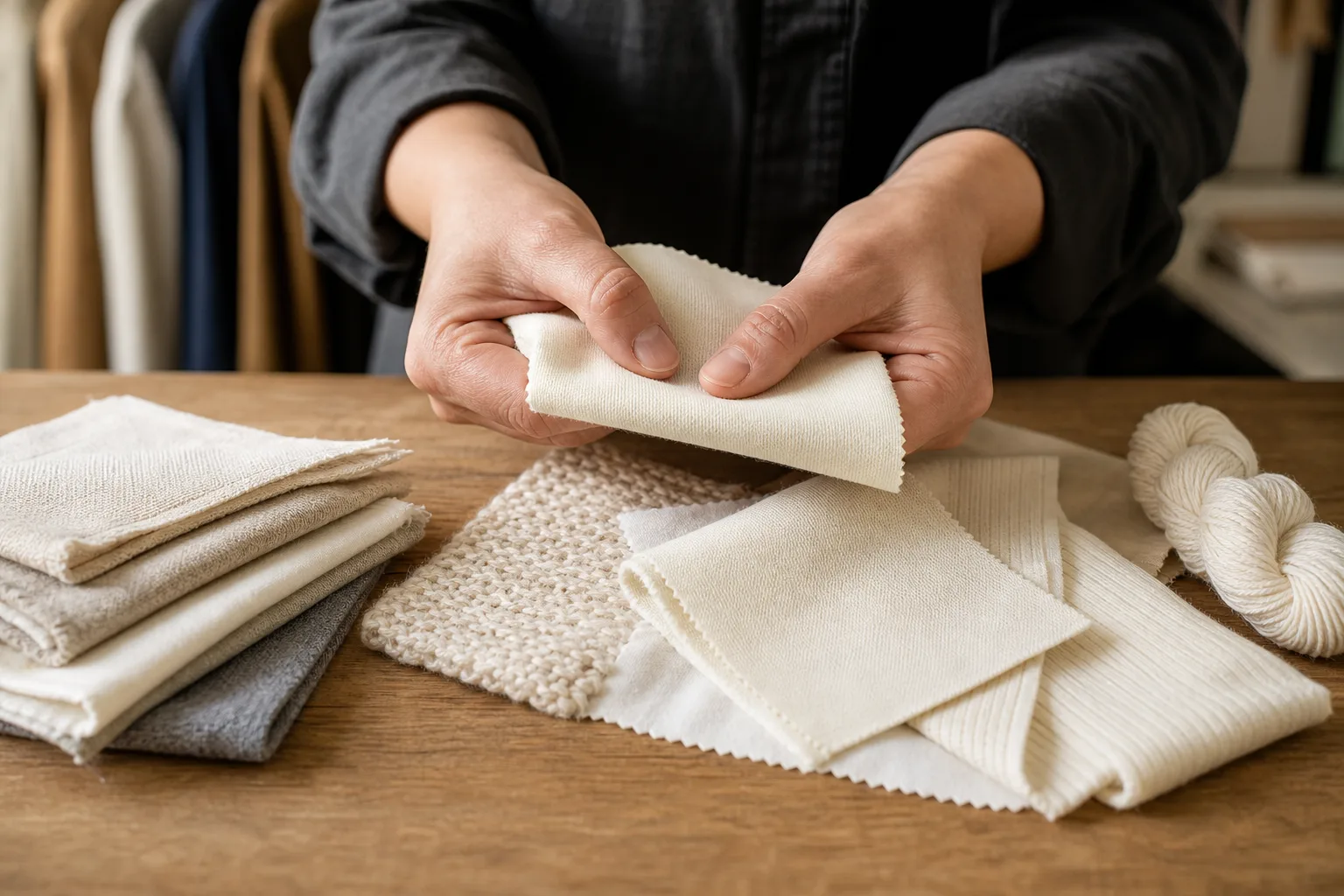
You may be able to identify cotton by touch provisionally, but not with certainty. Cotton fabrics often feel relatively soft, dry and non-slippery, yet their hand can range from crisp percale to smooth sateen, fuzzy flannel and plush terry. Yarn structure, fabric construction, finishing and blended fibers can all outweigh the tactile character of the cotton itself. Treat touch as a screening method, then check the fiber-content label or use qualified laboratory analysis when the result matters.
Can You Tell Whether Fabric Is Cotton by Touch?
Touch can help you form a reasonable hypothesis when you have no label or want to compare products. It is most useful when you handle an unknown fabric beside known reference samples of cotton, polyester, nylon, wool and regenerated cellulose fibers such as rayon or viscose.
The test becomes less reliable when a textile has been brushed, coated, mercerized, resin-finished, heavily softened or blended with another fiber. A fabric described as “cotton-feel” may be engineered to imitate a familiar cotton hand without containing cotton. Conversely, a genuine cotton fabric may feel unusually slick, stiff or stretchy because of its construction and treatment.
That distinction matters because fiber content and fabric hand are different properties. The Federal Trade Commission defines fibers, yarns and fabrics separately in U.S. textile law: fibers are assembled into yarn, and yarn or fibers are then made into fabric. The finished surface is therefore the result of several manufacturing stages, not fiber identity alone. The FTC also requires covered textile products to disclose their constituent fibers by generic name and percentage by weight. FTC cotton labeling guidance provides the relevant consumer and business requirements.
A Practical Cotton Touch-Test Method
Use the following method as a non-destructive screen. Do not make a buying, compliance or sourcing decision from one sensation alone.
1. Control the comparison
- Start with clean, dry hands. Lotion, sweat and oil change friction and perceived softness.
- Let the fabric reach room conditions rather than testing it immediately after it leaves a hot vehicle, cold warehouse or sealed package.
- If possible, compare the unknown material with a labeled cotton reference of similar weight and construction.
- Test more than one area. Avoid seams, prints, embroidery, coatings and worn patches.
2. Stroke the surface
Move your fingertips lightly across the face and back of the fabric in several directions. Many everyday cotton fabrics have a relatively dry, natural-feeling surface rather than a glassy or oily glide. Short fibers or a raised finish may produce fine fuzz. However, combed yarns, close weaves, mercerization and smoothing finishes can make cotton feel much cleaner and silkier.
3. Rub the fabric between finger and thumb
Use light pressure and notice both friction and surface texture. Ask whether the material feels powdery-dry, slick, waxy, hairy, papery or rubbery. These descriptions are more useful than simply calling it “soft.” A soft surface may come from fiber fineness, yarn preparation, brushing, laundering or a chemical softener; it is not proof of cotton or evidence of high quality.
4. Compress and release it
Gather a small section in your hand for several seconds, then release it. Observe the fabric’s body, spring and wrinkling without deliberately damaging the item. Many cotton constructions hold some temporary creasing, but wrinkle behavior varies widely. A wrinkle-resistant finish can make cotton recover more readily, while a loose or lightweight non-cotton fabric may wrinkle substantially.
5. Bend and drape it
Fold the material over a finger or let an available edge hang. This reveals stiffness, thickness and drape, but these are mainly fabric properties. A dense cotton canvas may resist bending, while a lightweight cotton voile may fall softly. A cotton-polyester blend can sit anywhere between those examples.
6. Check stretch and recovery gently
Pull lightly along the length, width and diagonal only when handling will not harm the product. Plain cotton woven fabric usually has limited lengthwise and widthwise stretch unless it contains elastane, uses stretch yarn technology or has a construction that permits movement. Cotton knits can stretch because loops deform, even when the fabric is 100% cotton. Stretch therefore says more about construction and added elastic fibers than it does about cotton itself.
How to Interpret What You Feel
Use several observations together. No row in this table confirms fiber composition on its own.
| Touch-test observation | Possible explanation | What it does not prove |
|---|---|---|
| Soft with a dry, slightly textured surface | Could be cotton made with spun yarn, especially after washing | That the fabric is 100% cotton |
| Very smooth with a subtle luster | Could be cotton sateen, mercerized cotton, fine yarn or a smoothing finish | That the material is silk or synthetic |
| Crisp and cool-feeling at first contact | Could reflect a lightweight, tightly woven construction such as percale | A particular cotton species, staple length or quality grade |
| Fuzzy, warm or brushed | Could be cotton flannel, fleece or another raised-surface textile | That the underlying fiber is cotton |
| Slick or low-friction | Could indicate filament yarn, a synthetic fiber, mercerization, coating or finishing | That cotton is absent |
| Stretchy with strong recovery | May indicate elastane, textured synthetic yarn or a resilient knit construction | That the main fiber is synthetic |
| Wrinkles after compression | May be consistent with untreated cotton or another low-recovery material | Fiber identity or overall durability |
| Stiff, heavy or rough | Could result from dense construction, coarse yarn, sizing, coating or an unfinished state | That the cotton fiber itself is low grade |
A better conclusion is “this feels consistent with a medium-weight cotton woven” rather than “this is definitely cotton.” Record the construction and surface clues that support the conclusion, especially in sourcing or quality-control work.
Why Genuine Cotton Can Feel So Different
Fiber properties influence yarn, but they are not directly readable by hand
Raw cotton varies in staple length, length uniformity, strength, micronaire, color and foreign-matter content. USDA classing uses controlled instrument measurements for properties including length, uniformity, strength, micronaire, color and trash, together with classer assessment of extraneous matter. These measurements support marketing and manufacturing decisions for raw cotton; they are not a consumer touch test for a finished shirt or sheet. USDA Cotton Classing Services explains the measured properties and controlled testing conditions.
Longer and more uniform fibers can support stronger, more even yarn production, while micronaire combines information related to fineness and maturity. CottonWorks describes these as measured fiber-quality factors with consequences for spinning, dyeing and end-product manufacturing. Once those fibers have been spun, woven or knitted, finished and laundered, however, you cannot assign a staple length, micronaire value or official fiber grade by rubbing the fabric. See CottonWorks’ cotton fiber quality overview for the distinction between measured raw-fiber properties and downstream products.
Yarn changes the surface
Carded yarn may present more protruding fiber ends than a carefully combed yarn. Ring-spun, open-end and plied yarns can differ in evenness, bulk, twist and surface character. High twist may make a yarn feel firmer; lower twist can feel softer but may behave differently under abrasion. These relationships are not universal quality rankings because the appropriate yarn depends on the intended product.
Construction controls body and texture
Knitting creates intermeshing loops, while weaving interlaces lengthwise and crosswise yarns. Knit cotton can feel flexible and yielding. Woven cotton can feel crisp, fluid, dense or rugged depending on weave, yarn density and weight. Terry towels add pile loops; flannel gains a raised surface; sateen places longer yarn floats at the face. Each construction modifies what the fingers detect.
Finishing can dominate the result
Mechanical and chemical processes may smooth, brush, soften, stiffen, coat or stabilize a textile. New fabric may also retain temporary processing materials that diminish after washing. A pre-purchase touch test therefore describes the product in its current condition, not necessarily how it will feel after repeated care.
What the Touch Test Cannot Verify
- Exact fiber percentages: Touch cannot distinguish reliably among 100% cotton, a cotton-rich blend and some convincing non-cotton fabrics.
- Cotton type or origin: It cannot authenticate Pima, Egyptian, Upland, Sea Island or a claimed country or region of cultivation.
- Raw-fiber grade: It cannot produce staple-length, strength, uniformity, micronaire, color-grade or trash measurements.
- Durability: Initial softness does not predict pilling, abrasion resistance, seam performance, shrinkage or appearance after washing.
- Safety or skin compatibility: A pleasant hand does not establish the absence of allergens, residues or irritating finishes.
- Sustainability: Organic status, farming practices, water use, labor conditions, recycled content, traceability and environmental impact require documentation or substantiated certification claims.
Marketing expressions such as “premium,” “luxury,” “hotel quality,” “buttery” and “cotton touch” are descriptions, not standardized touch-test results. Judge them against measurable product information rather than treating them as grades.
Use the Label and Testing in the Right Order
For consumers
Read the sewn-in fiber-content label before relying on feel. In the United States, covered products generally must list the generic names and percentages by weight of constituent fibers. A product should not be labeled “100% Cotton” when intentionally blended with another fiber, apart from permitted treatment of certain trim. Cotton-type claims must also be truthful and not deceptive under FTC guidance.
Then connect the label to the intended use. A cotton-elastane T-shirt may be preferable when recovery and close fit matter. A crisp cotton percale sheet and smooth cotton sateen sheet can both be accurately labeled cotton while feeling markedly different. Neither hand automatically establishes better quality.
For buyers and quality teams
Use touch to describe and compare approved samples, not to replace specifications. A useful assessment records surface friction, softness, stiffness, thickness, drape, stretch and recovery under consistent conditions. It should also identify the sample area and note whether the textile is washed, conditioned or finished.
When composition is disputed, when a shipment does not match its specification or when a fiber claim carries commercial or legal significance, send a representative sample to a qualified textile laboratory and state the question that must be answered. Raw-cotton HVI data may inform sourcing, but it does not by itself verify the fiber composition or performance of the finished article.
A final identification checklist
- Check the permanent fiber-content label.
- Compare the item with known fabrics of similar weight and construction.
- Describe the surface rather than relying on softness alone.
- Compress, drape and gently stretch the material.
- Consider yarn, weave or knit structure and finishing.
- Treat the conclusion as provisional if documentation is missing.
- Request traceable records or laboratory analysis when accuracy has financial, compliance or safety consequences.
The most defensible answer to how to identify cotton by touch is therefore conditional: touch can identify a cotton-like fabric hand and help compare construction or finishing, but it cannot authenticate cotton independently. Use your fingers to gather clues, the label to check declared content and appropriate testing to resolve consequential uncertainty.
Frequently asked questions
What does 100% cotton usually feel like?
Many cotton fabrics feel soft, dry and less slippery than smooth filament fabrics, but there is no single cotton feel. Percale may be crisp, sateen smooth, flannel fuzzy and canvas firm. Construction, yarn and finishing can be more noticeable than fiber identity.
Can polyester feel like cotton?
Yes. Polyester can be spun, textured, brushed and finished to produce a cotton-like surface. Touch alone may not reliably distinguish it from cotton or a cotton-polyester blend, so check the fiber-content label.
Does softer cotton mean higher quality?
Not necessarily. Softness can result from yarn structure, brushing, chemical softeners, laundering or a loose construction. Cotton quality also involves measurable and use-specific factors such as fiber properties, yarn evenness, fabric stability, durability and care performance.
Can touch identify Pima or Egyptian cotton?
No. A smooth or fine fabric does not authenticate a cotton type, origin or staple length. Named-cotton claims require reliable documentation, and consequential disputes may require appropriate laboratory analysis.
How this guide was prepared
This guide is based on desk research of USDA raw-cotton classing information, CottonWorks fiber and textile-quality guidance, and Federal Trade Commission textile-labeling requirements. No first-hand product trials, laboratory analyses, mill inspections or fiber-authentication tests were performed.
Sources and scope
- Cotton Fiber QualityCottonWorks by Cotton Incorporated
Explains measured raw-cotton quality factors, including staple length, length uniformity, strength, micronaire, color and trash, and how those factors affect processing and yarn.
Accessed 2026-10-13 - Cotton Classing ServicesUSDA Agricultural Marketing Service
Describes USDA instrument testing and classer determinations for raw cotton, including controlled measurement of length, uniformity, strength, micronaire, color and trash.
Accessed 2026-10-13 - Calling It Cotton: Labeling and Advertising Cotton ProductsFederal Trade Commission
Provides U.S. guidance on textile fiber-content statements, 100% cotton claims, blends, named cotton types and potentially deceptive marketing language.
Accessed 2026-10-13
Questions & discussion
Share a question or a useful experience about this guide. Comments appear immediately. Your name and comment are public. Email is optional and stays private; reply emails are not enabled yet. Comment privacy.