
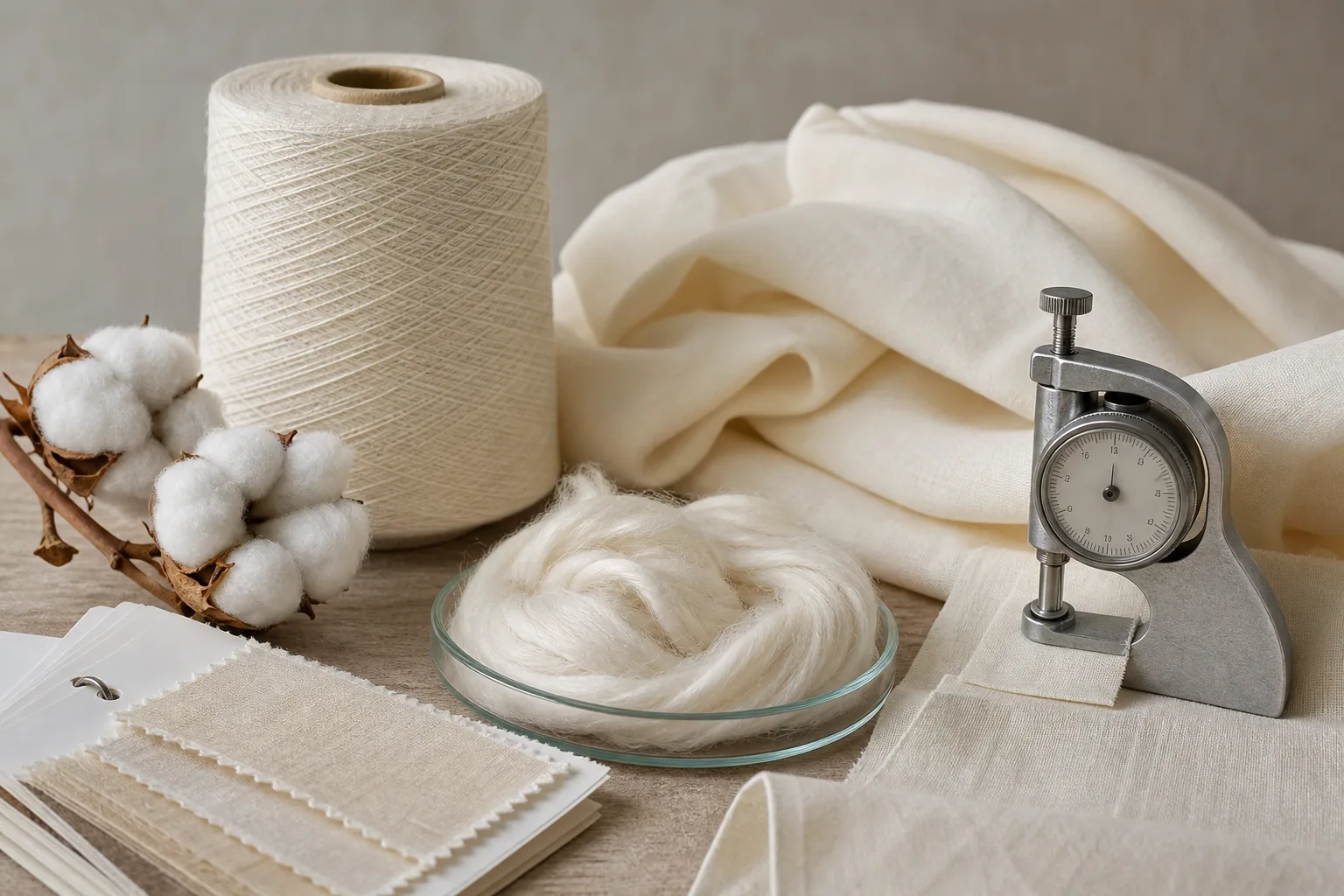
Sea Island cotton is a historically important name associated with long-staple cotton from the Gossypium barbadense species. Its fibers can support fine, strong and even yarns, making it suitable for refined apparel and household textiles. However, the name is not a laboratory result or a guarantee of softness, durability, origin or sustainability. Buyers should assess the stated fiber percentage, traceability and measurable quality alongside the yarn, construction and finish of the final product.
What is Sea Island cotton?
Sea Island cotton developed as a commercial crop in coastal areas of the southeastern United States and the Caribbean. USDA agricultural research describes the historic southeastern crop as Gossypium barbadense, the same species associated with American Pima and several other extra-long-staple cotton populations. Commercial production in the southeastern United States declined during the twentieth century, partly because its relatively long growing season increased exposure to boll-weevil damage. USDA Agricultural Research Service research provides further historical and agronomic context.
Terminology is not perfectly consistent across historical records, plant taxonomy and modern marketing. The USDA National Agricultural Library lists Sea Island cotton among the alternative terms associated with Gossypium barbadense, while some commercial explanations use the name more broadly for cotton connected with the coastal lowcountry. For practical sourcing, a product name should therefore be treated as the beginning of verification, not the conclusion.
Sea Island, Pima and Egyptian are not interchangeable guarantees
These names can overlap in discussions of species, geography and extra-long-staple cotton, but they do not all communicate the same information. Pima commonly identifies modern G. barbadense cultivars, while Egyptian cotton is a geographic description and may not by itself specify one species or fiber-quality range. Sea Island cotton has its own historical and trade context. None of the three names tells a buyer the yarn count, spinning system, fabric construction, finish or test performance of a finished product.
For a broader overview of the categories, see the cotton types guide and the comparison of Pima and Egyptian cotton.
Fiber properties that can make it valuable
The reputation of Sea Island cotton comes from fiber characteristics generally associated with selected G. barbadense cottons: long fibers, fineness and high strength. These attributes can give a spinner more scope to produce fine yarn without sacrificing as much yarn strength. They may also help reduce protruding fiber ends when preparation and spinning are well controlled.
Actual bales vary. Variety, weather, water availability, crop management, harvesting, ginning and storage can all influence the usable fiber. According to CottonWorks' fiber-quality guidance, cotton quality is evaluated through properties including length, length uniformity, strength, micronaire, color and trash. USDA classing likewise uses instrument measurements rather than relying on a premium name alone.
Measurements that matter
- Fiber length: Longer fibers generally permit finer yarns and can contribute to yarn strength and spinning efficiency. USDA reports upper-half-mean length rather than simply measuring the single longest fiber.
- Length uniformity: A long average is less useful if the sample also contains many short fibers. Better uniformity can support more even yarn and smoother processing.
- Fiber strength: Measured in grams per tex, strength indicates the force required to break a bundle of fibers. It can influence yarn strength, but it is not the same as finished-fabric durability.
- Micronaire: This airflow measurement reflects a combination of fineness and maturity. It should not be presented as a direct fineness measurement. Poorly matched micronaire can contribute to processing or shade-uniformity problems.
- Color and foreign matter: Natural color, leaf, trash and other extraneous material affect preparation, appearance and processing requirements.
The USDA cotton classing service measures these bale-level properties for marketing and manufacturing. Consumers rarely receive HVI data with a garment or sheet, but industry buyers can request specifications, tolerances and supporting documentation. Learn more in the guides to staple length, length uniformity, fiber strength and micronaire.
Fiber name does not determine the finished fabric
Sea Island cotton describes the claimed raw-material identity; it does not fully describe the textile. Two products made with similarly classified fiber can feel and perform differently because the fiber passes through multiple manufacturing stages.
Yarn preparation and spinning
Combing removes a portion of the shorter fibers after carding and can help produce a cleaner, finer and more even yarn. The spinning system, twist level, yarn count and whether yarns are single or plied also affect strength, hairiness, softness and abrasion behavior. A loosely twisted yarn may feel soft but shed or abrade more readily, while additional twist can improve cohesion at the expense of some initial softness.
Sea Island cotton is often positioned for fine yarns, but a high yarn count is not automatically better. The count must be appropriate for the fiber, construction and intended use. Compare combed and carded cotton and ring-spun and open-end yarn.
Construction and finishing
Woven percale, sateen, poplin and knit jersey arrange yarns differently. Construction changes air permeability, drape, surface friction, snagging and resistance to wear. A dense sateen sheet may feel smooth but retain more warmth than a comparably weighted percale. A fine jersey may feel supple but be more vulnerable to distortion than a stable woven fabric.
Finishes can add softness, sheen, dimensional stability or easy-care behavior. Mercerization, for example, can change luster, strength and dye response, but it is a processing treatment rather than a cotton type. Resin treatments, mechanical finishing, washing and coatings can also dominate the first-touch impression. That is why showroom softness should not be used as proof of Sea Island content or long-term quality.
Uses and practical trade-offs
Long, fine fibers are most useful where a manufacturer wants fine yarn, a smooth surface or a high strength-to-yarn-size relationship. They offer less obvious value when a heavy, bulky or deliberately textured construction is the main objective.
| Product or objective | Potential contribution | What else to check |
|---|---|---|
| Fine shirts and blouses | Fine yarns can support a light, smooth fabric with clear surface definition. | Seam quality, opacity, weave density, wrinkle finish and shrinkage. |
| Underwear and close-fitting knits | Smooth yarn may improve next-to-skin feel. | Knit stability, elastane content, seams, pilling and recovery. |
| Bed sheets | Fine yarn can produce a smooth, refined woven surface. | Weave, yarn count, thread-count method, weight, finishing and fit after washing. |
| Light knitwear and hosiery | Fineness can provide softness and low bulk. | Twist, ply, abrasion zones, snagging and dimensional stability. |
| Fine sewing or specialty thread | Long, strong fibers can support cohesive yarn at a small diameter. | Twist balance, evenness, finish and suitability for the machine or operation. |
Main trade-offs
- Higher input cost: Specialized fiber may increase material and verification costs without guaranteeing that the finished product is better designed.
- Limited value in some constructions: Heavy towels, coarse canvas or brushed fabrics may depend more on bulk, loop design, weight or finishing than on exceptionally fine fiber.
- Verification burden: A rare or premium name creates an incentive for vague descriptions. Traceability and truthful percentage disclosures matter.
- Fine does not mean indestructible: A very light fabric can wear through because there is less material at stress points, even when its individual fibers and yarns are strong.
- Feel can be engineered: Silicone softeners, mechanical finishing and laundering can produce a soft hand in many cotton types. Touch alone cannot authenticate the fiber.
How to assess a Sea Island cotton label
In the United States, a named cotton type must be presented truthfully. The Federal Trade Commission's cotton-labeling guidance gives “100% Sea Island Cotton” as an acceptable form when the claim is accurate. If a named cotton represents only part of a blend of cotton types, its percentage must be made clear rather than implying that all the fiber is Sea Island cotton.
Buyer checklist
- Read the sewn-in fiber label. Do not rely only on a product title, hang-tag or online search snippet.
- Look for a percentage. “Sea Island blend” is incomplete guidance unless the composition explains what is blended and in what proportion where required.
- Separate origin from species and quality. Ask where the cotton was grown, what identity system supports the claim and whether bale or yarn specifications are available.
- Check the yarn description. Combed, ring-spun, plied and yarn-count information can be more useful than adjectives such as luxury or hotel quality.
- Evaluate construction. For sheets, identify percale or sateen and do not use thread count alone. For knits, check weight, recovery and pilling performance.
- Ask what tests support performance claims. Relevant evidence may include dimensional change, pilling, abrasion, colorfastness, tensile or seam tests. A fiber-origin claim is not a substitute for these results.
- Confirm care instructions and return terms. Shrinkage, distortion or surface change often becomes visible only after laundering.
See how to assess cotton quality, how to verify cotton sheet labels and the limitations of thread-count comparisons.
Care and durability
Sea Island cotton does not require one universal care routine. Follow the product label because dye, finish, fabric weight, trims and construction determine the safe washing and drying conditions. In general, moderate washing, appropriate detergent dosing and controlled drying reduce avoidable stress on fine cotton textiles.
- Wash with similar colors and close fasteners that could snag a fine surface.
- Use the indicated water temperature rather than assuming hotter washing is necessary.
- Avoid overloading the machine, which can increase friction and leave detergent residues.
- Use chlorine bleach only when the care label permits it; repeated harsh bleaching can weaken cotton.
- Remove items promptly and use low or moderate dryer heat when allowed. Excess heat can increase shrinkage and set wrinkles.
- For lightweight knits, reshape after washing and avoid stretching them while wet.
Good care cannot correct weak seams, unstable construction or an unsuitable finish, but it can preserve the intended dimensions and surface longer. Consult the guides to washing cotton, preventing shrinkage and drying cotton.
Sustainability: evaluate the production system, not the name
Sea Island cotton is a material identity or marketing description, not a sustainability certification. It does not by itself establish organic production, lower water use, safer chemical management, fair labor conditions, biodiversity outcomes or verified chain of custody. Those questions require evidence about the specific farm, region, processor and assurance system.
Textile Exchange recommends assessing materials through multiple environmental and social considerations rather than treating one fiber as a universal solution. It also identifies verification, transparency and chain-of-custody systems as important tools for substantiating preferred-material claims. Its materials guidance supports asking what a standard covers—and what it does not cover.
Questions for a credible claim
- Is the claim about fiber identity, geographic origin, farming practices or the finished product?
- Which independent standard or documented protocol applies?
- Does the assurance cover only raw cotton, or also ginning, spinning, fabric production and the final product?
- Is there a chain-of-custody model connecting the claimed cotton to the item?
- Are environmental comparisons based on relevant regional or primary data?
- Does the product's construction support a useful service life, repairability and responsible care?
A durable, well-used product may offer more practical value than a poorly constructed item carrying an impressive fiber name. For more context, explore cotton sustainability, certifications and claims and the cotton supply chain.
Frequently asked questions
Is Sea Island cotton the same as Pima cotton?
They are related but should not be treated as identical product claims. Both names are associated with Gossypium barbadense cotton, but Sea Island has a distinct historical and trade context, while Pima commonly identifies modern cultivars. Neither name guarantees a particular yarn, fabric construction or performance result.
Is Sea Island cotton always extra-long staple?
Sea Island cotton is historically associated with long or extra-long fibers, but a retail name does not prove a measured staple length. Industry buyers should request fiber specifications or traceability evidence rather than inferring a precise classification from the name.
Does Sea Island cotton make the best bed sheets?
Not automatically. Long, fine fiber can support smooth, fine yarn, but sheet performance also depends on yarn preparation, weave, weight, finishing, dimensions, shrinkage and sewing quality. A well-made percale or sateen from another cotton type may outperform a poorly constructed Sea Island product.
Is Sea Island cotton sustainable?
The name alone does not establish a sustainability result. Assess farming practices, regional conditions, processing, chemical management, labor safeguards, durability and chain-of-custody evidence. Organic or other verified claims need their own applicable certification or documentation.
How this guide was prepared
This guide is based on desk research conducted on October 9, 2026 using USDA agricultural research and classing information, CottonWorks technical fiber guidance, Federal Trade Commission textile-labeling guidance and Textile Exchange materials guidance. No laboratory testing, product trial, farm visit, supplier audit or independent authentication was performed. Where historical and commercial terminology is inconsistent, the article states that limitation and prioritizes measurable fiber properties, accurate composition disclosures and documented traceability.
Sources and scope
- Cotton Fiber QualityCottonWorks
Definitions and manufacturing relevance of fiber length, length uniformity, strength, micronaire, color and trash measurements.
Accessed 2026-10-09 - Cotton Classing ServicesUSDA Agricultural Marketing Service
USDA instrument classing procedures and the bale-level cotton properties measured for marketing and manufacturing.
Accessed 2026-10-09 - Yield Performance and Fiber Quality of Pima Cotton Grown in the Southeast United StatesUSDA Agricultural Research Service
The relationship between Sea Island and Gossypium barbadense cotton, historical southeastern production and comparisons of Pima and Upland fiber quality.
Accessed 2026-10-09 - Calling It Cotton: Labeling and Advertising Cotton ProductsFederal Trade Commission
U.S. requirements for truthful use of named cotton types, fiber percentages and blended-cotton disclosures.
Accessed 2026-10-09 - Materials PortfolioTextile Exchange
A multi-factor approach to material sustainability, including verification, transparency and chain-of-custody considerations.
Accessed 2026-10-09
Questions & discussion
Share a question or a useful experience about this guide. Comments appear immediately. Your name and comment are public. Email is optional and stays private; reply emails are not enabled yet. Comment privacy.