
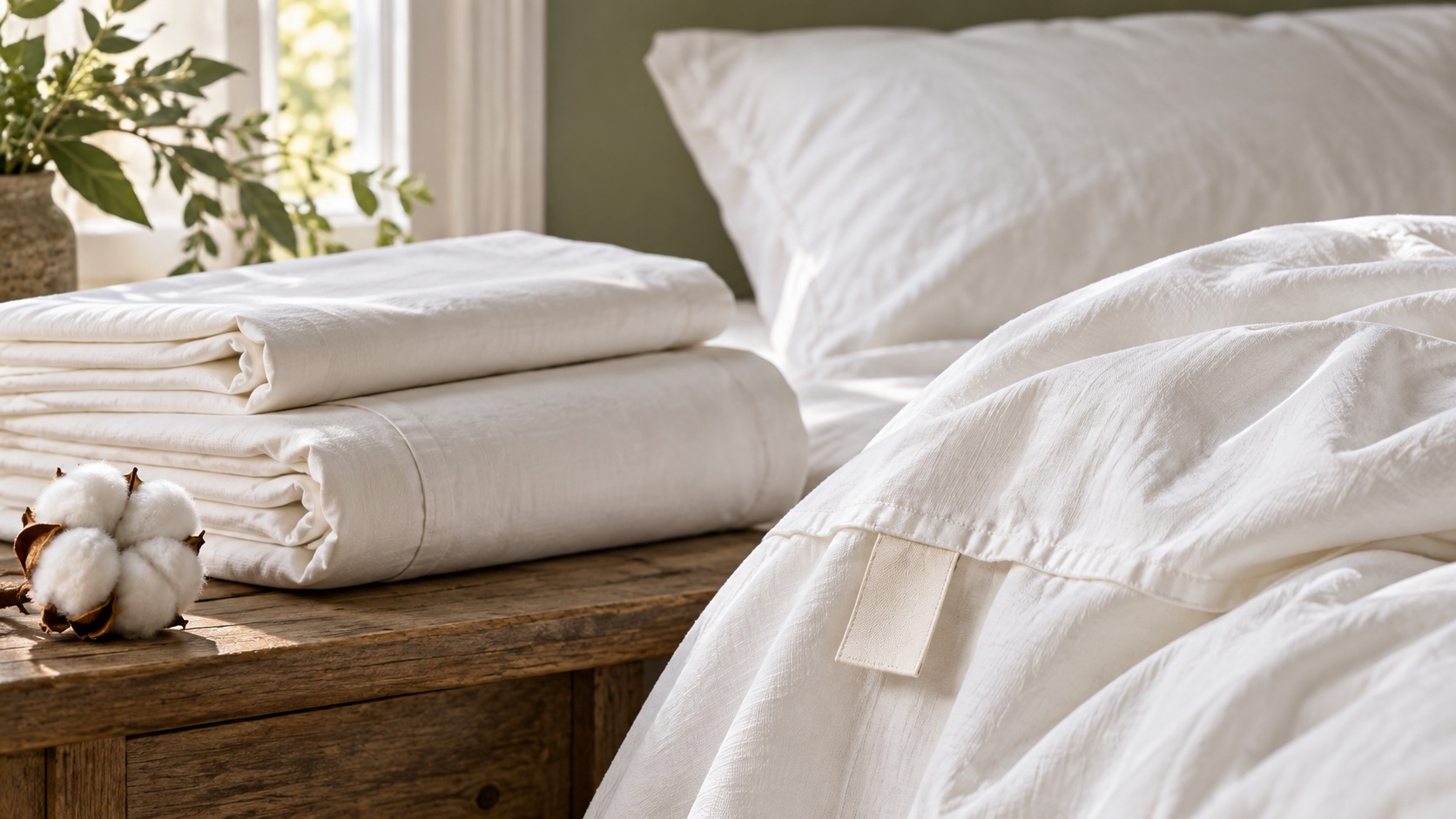
Supima is a trademark for American-grown extra-long-staple Pima cotton. It tells you about a claimed fiber identity and authorized supply chain; it does not tell you how a particular sheet will fit, feel after washing or stand up to use. For bedding, make two separate decisions: can the seller support the Supima claim, and does the finished fabric suit your bed and care routine?
What Supima means
Supima identifies American-grown Pima cotton sold under the Supima trademark. Pima is the broader cotton designation; the Supima name adds the trademark owner’s authorization requirements. The crop’s American origin does not mean a sheet was woven or sewn in the United States. Check the finished-product origin separately. Supima’s FAQ explains the identity and origin of the fiber; the current licensing information describes authorization. Both were accessed on October 26, 2026.
Treat this as a fiber-and-traceability claim, rather than an all-purpose certification. A Supima statement alone does not answer whether a textile is organic, how it was finished or whether a particular washing result was tested. Ask for evidence addressing each additional claim separately.
What the fiber qualities mean for your sheets
Extra-long-staple cotton gives a manufacturer useful material to work with. The finished result still depends on yarn design, fabric construction, dyeing and finishing. CottonWorks’ fiber guidance, accessed October 26, 2026, separates length, length uniformity, strength and micronaire rather than treating them as a single quality score.
| Quality point | Meaning for a Supima product | What to check in the finished item |
|---|---|---|
| Fiber length | Longer fibers can support even, fine yarns. | Is the weave you want clearly specified, and does the fabric have the handle you prefer? |
| Fiber strength | A useful input to yarn manufacture, rather than a promise about a finished seam. | Look at seams, hems and the seller’s product-specific durability information. |
| Fineness and maturity | Micronaire reflects both; it is not a simple softness rating. | Avoid a sales claim that turns one fiber measurement into guaranteed comfort. |
| Softness | A fabric sensation affected by its construction and finish. | If possible, compare a swatch and ask how the fabric changes after label-compliant laundering. |
Use the staple-length guide and fiber-strength guide for the underlying measurements. A buyer does not need a bale report to choose a household sheet, but a commercial order should connect any supplied fiber data to the material being purchased.
Do not convert a raw-fiber advantage into a fixed product lifespan or a promise of no pilling. CottonWorks treats yarn, fabric and post-laundering performance as separate subjects in its quality-testing guidance, accessed October 26, 2026.
Where Supima can be useful
Sheets, pillowcases and duvet covers
Start with the fabric you want to sleep under. CottonWorks describes percale and sateen as different constructions with different feels; its home buyer’s guide, accessed October 26, 2026, places fiber choice alongside yarn, weave and finish. Supima can be used in either construction. The fiber name does not choose between them for you.
For a fitted sheet, write down your mattress depth including any topper, then check the stated fit and care instructions. Ask whether the supplier can provide finished dimensions after its stated wash procedure. A supported fiber claim is still a poor trade if the sheet will not fit your bed. For a duvet cover, check closure, ties and dimensions before paying extra for the cotton name.
Towels
Compare pile construction, weight, dimensions and the drying routine available in your home. Supima may be part of a premium towel specification, but the name alone cannot settle absorbency, lint or drying time. Ask about those outcomes directly and keep them separate from the fiber-origin question.
Clothing
For a T-shirt or other garment, examine the knit or weave, seams, fit and care requirements. A soft display sample does not settle how the garment will fit after washing. Where a Supima premium competes with a better cut or a clearer return policy, decide which feature solves your actual problem.
Paying more makes sense only when the identity is supported and the complete product offers something you value. No universal premium is justified by the name alone.
Is the Supima premium worth paying?

A Supima claim can give you a meaningful starting point when the seller can connect it to the actual item. Decide whether to pay more only after three checks: can the claim be supported, does the finished product suit your needs, and is the price difference worthwhile to you? The verification steps below help with the first question. A recognizable mark alone does not tell you whether the sheet fits your mattress or whether you like its weave.
Compare an exact Supima sheet with another sheet you would consider buying. Look at the weave, fit, seam and hem construction, stated care and return terms, then compare their prices. A premium can make sense when the documented fiber claim and the finished item both matter to you. Write down the dimensions you need before comparing prices. Consider whether the item is sold as a full set or separately, and compare the exact size and pieces included. The cheapest advertised figure may not correspond to the combination you need. A seller that provides a swatch or clear return terms gives you another way to assess the fabric in your own room. If you cannot verify the claim or the weave and dimensions do not work for your bed, the name itself is a weak reason to pay extra. Use the sleep-feel decision guide to identify the construction you prefer.
Questions about Giza claims
A seller may also offer sheets naming a Giza variety. Ask which variety is claimed, what evidence connects it to the sheet, and whether the yarn and weave are disclosed. Sferra Giza 45 and Matouk Gatsby have been mentioned as high-end examples; mentioning them is not a recommendation or a test of either product. A separate MyPillow Giza claim has been questioned in individual accounts without a clear conclusion. For any brand, ask the seller to explain the specific fiber claim rather than inferring the content from a name. The Pima, Supima and Egyptian comparison explains the different claims without a universal ranking.
Read durability stories as individual experiences
One owner described a Thomas Lee Supima percale sheet as lasting for a long time and feeling crisper after laundering. The same account used line drying and avoided machine drying and ironing; those choices may matter, but the report cannot establish why that sheet lasted. Another individual placed Peacock Alley in a similar category. These are personal accounts, not independent tests or expected lifespans. Other owners report long use from ordinary cotton sheets as well.
A sheet’s useful life can vary with fit, use, washing, pets, children and the sleeper’s movements. A report about one household cannot predict another’s result. Ask about the seller’s care guidance and return policy, and compare the product you will actually receive. Available accounts do not establish why Supima items might be less common in a given store; selection and authorization can vary, so check current availability and the exact item’s evidence rather than assuming a cause.
How to check a Supima claim
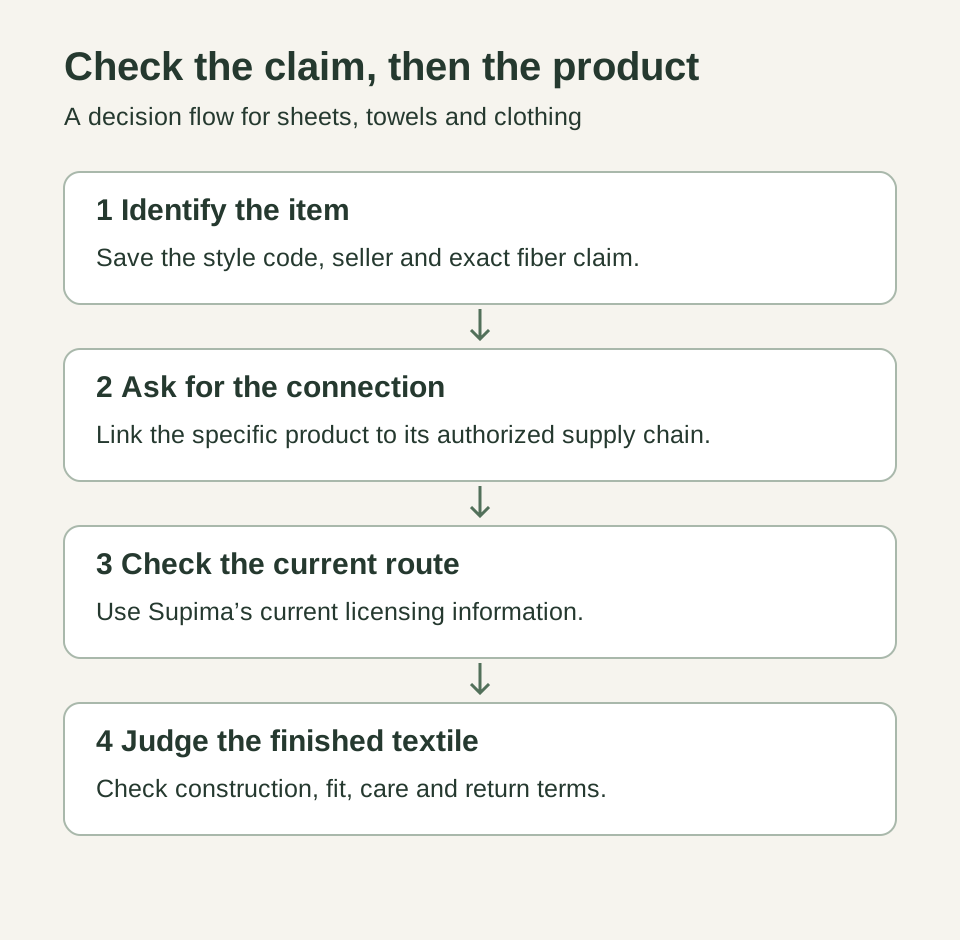
Read this flowchart as a decision sequence: identify the exact product, ask for its supporting records, then resolve gaps before placing an order.
- Save the exact claim. Keep the listing URL, seller’s name, product code, fiber-content statement, care instructions and a dated copy of the advertised Supima wording. Photograph the packaging and sewn-in label when the item arrives.
- Ask a question tied to that product. Request confirmation that the specific style or shipment is supplied through Supima’s current authorized route. A company-level claim without a connection to your item leaves an important gap.
- Use the current verification route. Supima’s licensing page describes the AQRe Project, combining digital supply-chain records with physical authentication. It also states that the old paper Proof of License is no longer issued. Do not make an old-style certificate the only acceptable answer, or treat an old scan as proof of a new order. Source: Supima licensing information, accessed October 26, 2026.
- Keep the evidence proportionate to the purchase. For a household purchase, keep the seller’s written explanation and return terms. For a bulk order, request a link between the order, material records and the supplier’s current authorization. Resolve unclear claims through the official contact provided by Supima.
- Separate identity from performance. Ask for the product’s own fit, laundering and construction information. A fiber-authentication record does not replace finished-product evaluation.
Touch can help you decide whether you like a fabric. It cannot authenticate the trademark. If the seller cannot explain its claim, avoid paying a premium on the strength of that claim alone. Continue with the broader cotton buying checks when comparing the rest of the specification.
Common mix-ups
- “Long-staple” means Supima. A length category does not by itself identify American-grown Pima or trademark authorization.
- “Pima” and “Supima” mean identical evidence. The names are related, but a Supima claim carries its own authorization question.
- “Egyptian cotton” is another name for Supima. They describe different identity claims. Use the Pima and Egyptian comparison for that separate decision rather than inferring a winner from geography.
- “100% cotton” settles the named cotton type. It identifies generic fiber content; ask separately about the named Supima claim and how it relates to the item.
- A high thread count proves authenticity. Construction details and fiber identity answer different questions. Keep both in your purchase record.
The useful end point is a product record you can understand: what the cotton claim means, how the seller supports it, and why the finished textile fits your use.
How this guide was prepared
This guide connects the Supima trademark owner's current identification and licensing information with Cotton Incorporated's fiber and finished-textile guidance. The buying checks are practical interpretation of those sources, not results from product testing. Sources were accessed on October 26, 2026.
Sources and scope
- Supima frequently asked questionsSupima
Supima's American-grown extra-long-staple identity and its relationship to Pima.
Accessed 2026-10-26 - Supima licensing program and AQRe ProjectSupima
Current authorization route, digital traceability, physical authentication and replacement of paper licensing certificates.
Accessed 2026-10-26 - Cotton Fiber QualityCotton Incorporated, CottonWorks
Length, strength and micronaire as distinct fiber measurements with manufacturing consequences.
Accessed 2026-10-26 - Cotton Home Buyer's GuideCotton Incorporated, CottonWorks
Home-textile uses and the importance of yarn, weave, towel construction and finishing.
Accessed 2026-10-26 - Quality TestingCotton Incorporated, CottonWorks
Finished-product checks for appearance, dimensional stability and performance after laundering.
Accessed 2026-10-26 - Reddit discussion · r/Bedding · 23 comments
Questions & discussion
Share a question or a useful experience about this guide. Comments appear immediately. Your name and comment are public. Email is optional and stays private; reply emails are not enabled yet. Comment privacy.