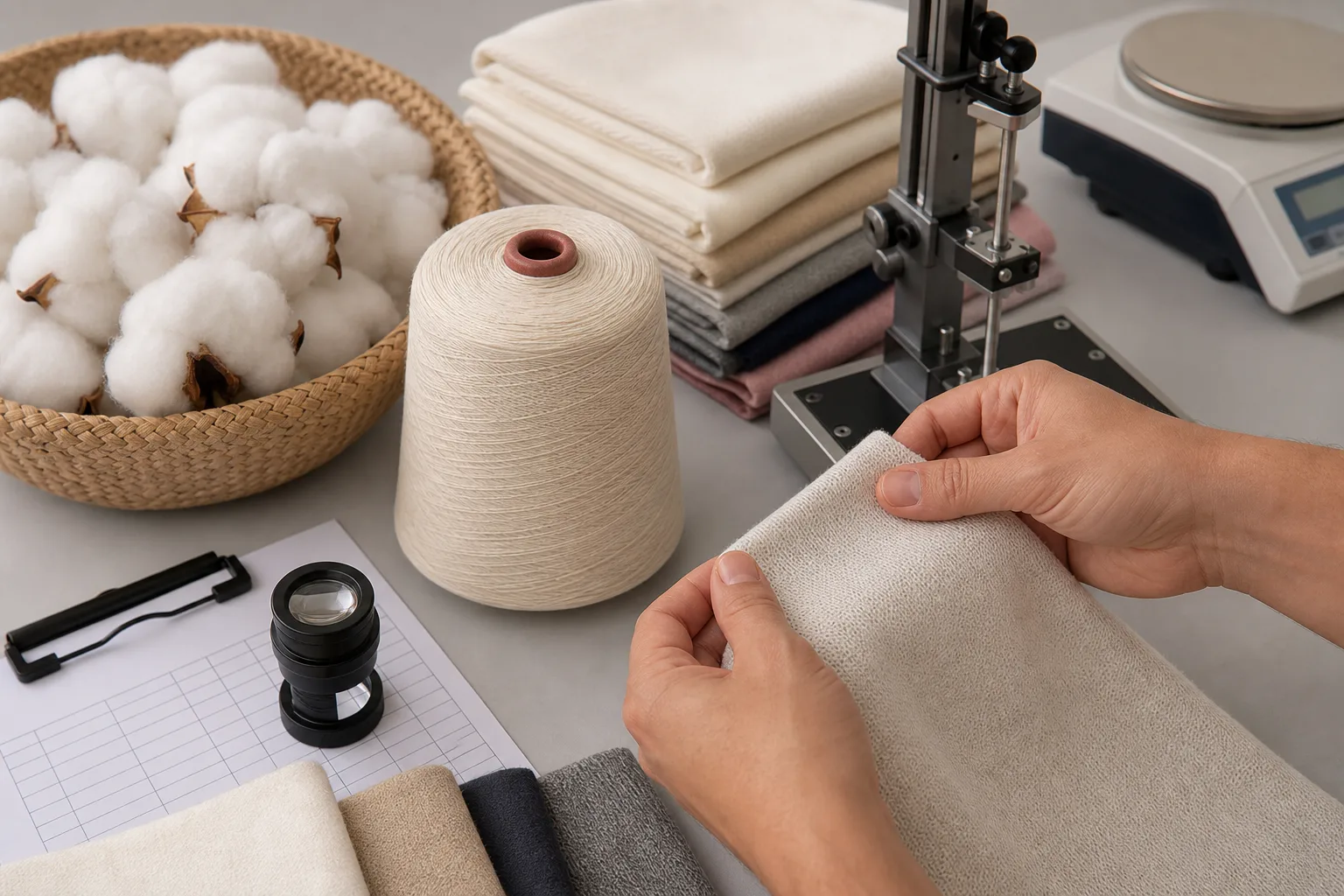
Upland cotton is the widely cultivated cotton species Gossypium hirsutum. It supplies fiber for products ranging from T-shirts and denim to sheets, towels, upholstery and medical textiles. For buyers, its main benefit is versatility: mills can select different Upland fiber grades, yarn systems, constructions and finishes to meet a broad range of performance and cost targets. However, “Upland” identifies a cotton type, not a guaranteed quality tier. A good purchasing decision therefore requires more than recognizing the name; it requires checking the measurable fiber properties and the way the finished product was engineered.
What is Upland cotton?
Upland and Pima are genuinely different commercial cotton species. Upland is Gossypium hirsutum, while American Pima is Gossypium barbadense. The USDA describes Upland as the predominant cotton type and gives its characteristic raw-fiber length as approximately 1 to 1 1/4 inches, compared with 1 3/8 inches or longer for Pima. These ranges are useful for orientation, but individual lots still need to be evaluated rather than judged by species alone. USDA Economic Research Service: Cotton Sector at a Glance
What the name does and does not tell you
- It does tell you: the botanical and commercial category of the cotton fiber.
- It may suggest: suitability for many mainstream spun-yarn applications, depending on the lot specifications.
- It does not prove: a particular thread count, yarn count, fabric weight, strength, softness, shrinkage result, colorfastness or service life.
- It does not establish: organic status, farming impacts, traceability or certification.
Upland cotton should not automatically be described as “low quality” because its commercial range is broad. Breeding, growing conditions, harvesting, ginning and fiber selection can produce meaningful differences among Upland lots. Mills can also blend lots to create a more consistent input for a specified yarn.
How Upland cotton quality is measured
Raw cotton quality is evaluated with standardized measurements rather than adjectives such as “premium” or “luxury.” USDA cotton classification includes instrument measurements for length, length uniformity, strength, micronaire, color and trash, together with classer identification of extraneous matter. USDA states that a sample from every bale entering its grading operation is tested using cotton-classification instrumentation. USDA Agricultural Marketing Service: Cotton Classing Services
These data help merchants and mills match raw fiber to processing requirements. They do not, by themselves, predict every characteristic of a finished garment or household textile.
Practical guide to the main fiber measurements
| Measurement | What it describes | Why a mill or buyer cares | What it cannot prove alone |
|---|---|---|---|
| Staple length | The upper-half-mean length of a prepared fiber sample | Influences spinning efficiency and the possible balance of yarn fineness, evenness and strength | Finished softness, durability or fabric weight |
| Length uniformity | How consistent the fiber lengths are within a sample | Lower variation generally supports more stable processing and more even yarn | That a garment will resist pilling or abrasion |
| Fiber strength | The force required to break a bundle of fibers, reported in grams per tex | Helps mills design yarns that withstand spinning and later manufacturing | The breaking strength of the final fabric or seams |
| Micronaire | An air-permeability measurement influenced by both fineness and maturity | Relevant to processing behavior, yarn design and dye uniformity | Fineness or maturity as separate, independent values |
| Color | Raw fiber reflectance and yellowness | Affects grading, preparation and the consistency of light-colored products | Finished-product colorfastness |
| Leaf, trash and extraneous matter | Non-lint material or foreign matter present in the sample | Can influence cleaning requirements, waste and processing performance | That a finished textile is unsafe or visibly contaminated |
CottonWorks explains that staple length and length uniformity affect yarn strength, evenness and spinning efficiency. It also cautions that micronaire combines information about fineness and maturity rather than directly measuring fineness alone. CottonWorks: Cotton Fiber Quality See the broader cotton quality guide and HVI testing guide for more detail.
Uses and practical benefits
Upland cotton is used across many product categories because its properties can be selected and engineered for different purposes. Common applications include jersey clothing, denim, woven shirts, underwear, bedding, towels, curtains, upholstery and healthcare products. The relevant benefit depends on the specification: a soft jersey, rigid denim and absorbent towel do not require identical yarns or constructions.
Where it is a strong commercial fit
- Everyday apparel: Upland can be spun into yarns for woven or knitted basics, with fabric weight and finishing adjusted for the intended hand and durability.
- Denim and workwear: yarn size, twist, weave density, dyeing and finishing can be balanced for structure, appearance and wear performance.
- Sheets and bedding: yarn quality, weave, fabric mass and finishing matter more than thread count or cotton type in isolation.
- Towels: loop design, yarn twist, pile density and finishing strongly influence absorbency, drying behavior and feel.
- Industrial and medical uses: the product must be evaluated against its application-specific specifications; the word “cotton” is not a substitute for compliance or performance evidence.
Fiber is only the first design decision
A finished textile is a system. Fiber properties affect the yarn, but yarn structure, fabric construction, wet processing, finishing and sewing also affect the result. CottonWorks notes that yarn and fabric construction contain multiple elements affecting both performance and cost. CottonWorks: Quality Testing
For example, combing can remove short fibers and improve yarn uniformity; yarn twist changes strength and feel; a tight woven construction behaves differently from a loose knit; and brushing, mercerization, resin treatment or mechanical compaction may alter appearance and performance. Consequently, “100% Upland cotton” does not guarantee that two products will feel, wash or wear alike. Explore the cotton fabrics and cotton science guides to separate these variables.
Upland cotton compared with Pima cotton
Pima is usually chosen when its extra-long fiber characteristics support a specific fine-yarn or smooth-surface objective. Upland covers a wider mainstream range and may be the more practical input when the product does not require extra-long staple fiber. Neither name removes the need to inspect the yarn, construction, finish and performance specification.
| Buying question | Upland cotton | Pima cotton |
|---|---|---|
| Species | Gossypium hirsutum | Gossypium barbadense |
| Typical USDA fiber-length description | About 1 to 1 1/4 inches | 1 3/8 inches or longer |
| Common commercial role | Broad range of apparel, home and technical applications | Fine yarns, sewing thread and selected higher-end textiles |
| Does the name guarantee a superior finished product? | No | No |
| What should be compared? | Fiber data where relevant, yarn system and count, construction, fabric weight, finish, test results, care requirements and claim documentation | |
A well-engineered Upland product can outperform a poorly designed product carrying a more prestigious fiber name. Conversely, Upland may not be the most efficient choice for an exceptionally fine yarn specification. Compare actual requirements in the cotton comparison guides rather than treating either species as universally better.
How to identify Upland cotton
For consumers
Start with the sewn-in fiber-content label and product description. In the United States, the FTC requires covered textile products to disclose their constituent fibers. If a seller names a particular cotton type, the statement must be truthful and not deceptive. A product containing multiple cotton types cannot be presented as if it were made entirely from only one of them. Federal Trade Commission: Calling It Cotton
Touch and appearance are not reliable methods of authenticating Upland cotton. Softness can come from yarn design and finishing, while sheen can be influenced by fiber preparation, fabric structure and treatments. If the label says only “100% cotton,” it confirms the generic fiber content but does not necessarily identify the cotton species.
For brands, mills and commercial buyers
Ask for evidence proportionate to the claim and transaction. Depending on the purchasing stage, useful documentation may include:
- A precise fiber-content declaration identifying Upland cotton where that distinction is commercially material.
- Supplier specifications and tolerances for the raw cotton, yarn, greige fabric or finished fabric.
- USDA classification or equivalent recognized fiber data when sourcing traceable raw bales.
- Yarn count, spinning system, twist, ply and blend information.
- Fabric construction, mass, finishing route and agreed performance-test results.
- Transaction or chain-of-custody records for certification and sourcing claims.
Do not infer species, origin or certification from a bale’s color, a fabric’s hand or an unsupported sales description. If authentication is contractually important, define the accepted documentation and verification method before ordering.
Buying checklist for Upland cotton products
Use this checklist to separate measurable requirements from marketing language:
- End use: What must the product do during manufacture, use and care?
- Fiber content: Is it all cotton or a blend, and does the label identify Upland specifically?
- Raw-fiber specification: Are length, uniformity, strength, micronaire, color and foreign-matter limits relevant and documented?
- Yarn: What spinning system, count, twist, ply and evenness are specified?
- Construction: Is the fabric knit or woven, and what are its density, weight and structural details?
- Finish: Has the textile been softened, brushed, compacted, mercerized, coated or treated for a performance claim?
- Testing: Are the methods, acceptance limits and sampling rules named rather than summarized as “tested for quality”?
- Labels: Do the fiber, origin and care statements match the product description?
- Sustainability: Is each claim tied to a defined program, scope and chain-of-custody model?
- Consistency: Are tolerances defined for repeat orders and different production lots?
Consumers may not have access to industrial specifications, but they can still compare fabric weight, construction, care instructions, dimensions, return terms and specific performance statements. Commercial buyers should convert these expectations into an agreed specification and inspection plan. See the cotton buying guides and textile testing guides for the next steps.
Care and sustainability claims
Care depends on the complete product
Upland cotton can shrink, wrinkle, fade or distort under some conditions, but species alone does not determine the outcome. CottonWorks identifies fiber, yarn, construction, wet processing, finishing, garment manufacture and laundering as factors affecting shrinkage. Knitted fabrics are generally more difficult to stabilize than woven fabrics. CottonWorks: Shrinkage and Skewing
Follow the product’s care label rather than a generic rule for cotton. The FTC Care Labeling Rule requires covered manufacturers and importers to provide regular care instructions supported by a reasonable basis. Federal Trade Commission: Care Labeling Rule For cautious household care, washing only as often as necessary, using the label-approved temperature and avoiding excessive drying heat may help reduce avoidable stress. Visit the cotton care guide for product-specific advice.
Upland is not a sustainability certification
Upland cotton may be grown under conventional, organic or other defined agricultural programs. The botanical name therefore cannot substantiate claims such as “organic,” “regenerative,” “responsibly sourced” or “low impact.” Each claim needs its own criteria, scope and evidence.
For example, Textile Exchange describes the Organic Content Standard as a voluntary chain-of-custody standard for verifying certified organic material; it does not address chemical use or wider social and environmental performance beyond organic-material integrity. Textile Exchange: Organic Content Standard Better Cotton supports both mass-balance and physical chain-of-custody models, which are not interchangeable statements about the cotton physically present in a particular retail item. Better Cotton: Chain of Custody
Ask what was certified, which supply-chain model was used, whether the final product is eligible to carry the claim and how current certification can be verified. A logo or broad environmental phrase should not be treated as proof of every possible benefit. Learn how to assess these distinctions in the cotton sustainability guide.
The commercial conclusion
Upland cotton is a flexible and widely available textile input, but its commercial value depends on fitness for purpose. Choose it when the measurable fiber profile, mill process, yarn, fabric construction, finish and verified claims meet the product brief. Reject shortcuts that equate a species name with guaranteed softness, durability, luxury or sustainability. The strongest specification connects raw-fiber evidence to manufacturing controls and finished-product requirements while making clear where results remain uncertain.
Frequently asked questions
Is Upland cotton good quality?
It can be, but Upland is a cotton species rather than a quality grade. Evaluate measurable fiber properties alongside the yarn, fabric construction, finish and relevant finished-product tests.
Is Upland cotton the same as Pima cotton?
No. Upland is Gossypium hirsutum, while Pima is Gossypium barbadense. Pima is classified as extra-long staple, whereas Upland covers the principal mainstream range of commercial cotton applications.
Can I identify Upland cotton by touch?
Not reliably. Yarn design, fabric construction and finishing can substantially change softness, smoothness and appearance. Check the fiber-content label and, for commercial sourcing, supporting specifications and traceability records.
Does 100% cotton mean 100% Upland cotton?
Not necessarily. A 100% cotton label identifies the generic fiber content but may not name the cotton species. If a specific cotton type is claimed, the statement should accurately reflect the product's composition.
Is Upland cotton organic or sustainable?
The name alone establishes neither. Upland cotton can be grown under different production systems. Organic, responsible-sourcing and environmental claims require separate standards, evidence and appropriate chain-of-custody documentation.
How this guide was prepared
This entity guide is based on desk research completed on September 13, 2026. It synthesizes USDA cotton classification and sector guidance, FTC textile-labeling and care requirements, CottonWorks fiber and manufacturing references, and current chain-of-custody information from Textile Exchange and Better Cotton. No laboratory testing, farm or mill visits, supplier audits, product trials, certification checks or first-hand purchasing experience were performed.
Review status: Publishable quality advisory.
Sources and scope
- Cotton and Wool — Cotton Sector at a GlanceUSDA Economic Research Service
Botanical distinction, characteristic fiber-length ranges and principal end uses of Upland and Pima cotton.
Accessed 2026-09-13 - Cotton Classing ServicesUSDA Agricultural Marketing Service
Official U.S. cotton classification measurements, instrument testing and visual assessment of extraneous matter.
Accessed 2026-09-13 - Cotton Fiber QualityCottonWorks
Definitions and manufacturing significance of staple length, uniformity, strength, micronaire, color and trash.
Accessed 2026-09-13 - Calling It Cotton: Labeling and Advertising Cotton ProductsFederal Trade Commission
U.S. requirements and examples concerning fiber-content labels and claims about named cotton types.
Accessed 2026-09-13 - Quality TestingCottonWorks
The separate roles of fiber, yarn and fabric construction in textile performance and specification.
Accessed 2026-09-13 - Shrinkage and SkewingCottonWorks
Factors affecting cotton-product shrinkage, including yarn, construction, finishing, manufacture and care.
Accessed 2026-09-13 - Care Labeling of Textile Wearing Apparel and Certain Piece GoodsFederal Trade Commission
Requirements for supported care instructions on covered apparel and textile piece goods.
Accessed 2026-09-13 - Organic Content StandardTextile Exchange
Scope of the Organic Content Standard, third-party certification and organic-material chain of custody.
Accessed 2026-09-13 - Chain of CustodyBetter Cotton
Distinction between mass-balance and physical Better Cotton chain-of-custody models.
Accessed 2026-09-13